
Working at height safety comes down to one sequence: avoid the work if you can, prevent a fall if you cannot, and only then limit the harm if someone does fall. In Great Britain the Health and Safety Executive (HSE) expects employers to follow that order every time, and to plan, supervise and equip each task accordingly. This guide explains what counts as working at height, how the hierarchy of control works in practice, what the rules look like in other countries, and gives you a checklist you can use before a job starts.
TL;DR
- Working at height means any work where someone could fall and be hurt, including below ground level. There is no safe minimum height to rely on.
- Follow the HSE order: avoid, use an existing safe place, use equipment that protects everyone, use work restraint, and only then mitigate a fall.
- Personal fall arrest is never the first choice. It depends on user skill, correct set-up and a rescue plan.
- Plan, supervise, train, inspect and record. A method statement is the simplest way to tell everyone the hazards and precautions.
- Rules differ by country. UK duties sit with HSE guidance; the US, Australia, New Zealand and Mexico set their own thresholds.
Table of Contents
- What counts as working at height
- The hierarchy of control: the order that matters
- Planning, supervision and paperwork
- Equipment, inspection and fall protection
- Rescue planning: the part most plans skip
- Training that actually changes behaviour
- A working at height checklist
- Our perspective
- Safety training built around your sites
- FAQ
- Sources
What counts as working at height
The definition is wider than most people expect. WorkSafe New Zealand describes it as working in a place where, if precautions are not taken, a worker could fall and be hurt, injured or die, and that includes working above or below ground level. A trench, a pit or an open shaft therefore counts as much as a roof.
That has a practical consequence. You do not start from a number of metres and ask whether the rule applies. You start from the task and ask what happens if someone slips. The same New Zealand guidance states there is no minimum height threshold: a fall risk from any height has to be managed.
Typical examples in a British workplace:
- Changing a light fitting from a stepladder in an office or warehouse.
- Roof work, including surveys, repairs and solar panel installation.
- Loading or sheeting vehicles, and working near loading bay edges.
- Scaffold erection, window cleaning and façade maintenance.
- Maintenance on mezzanines, gantries, tanks and plant access platforms.
- Work near an unprotected edge or on a fragile surface such as a roof light.
Falls from height are a recurring cause of serious injury and death in workplaces, which is why HSE treats them as a priority topic rather than a niche construction issue. Offices, factories, oil and gas sites, healthcare estates and civil engineering projects all generate this kind of work.
The hierarchy of control: the order that matters
The core of UK practice is a hierarchy, set out in HSE guidance on assessing all work at height. It runs in this order:
- Avoid work at height where it is reasonably practicable to do so.
- Use an existing safe place of work, such as a roof with permanent edge protection.
- Use work equipment that protects everyone, for example a mobile elevating work platform or scaffold with guardrails, so protection does not depend on each person’s behaviour.
- Use work restraint, which stops a person reaching the edge at all.
- Mitigate the consequences of a fall, using nets, airbags or personal fall arrest.
HSE is blunt about how this is used. The hierarchy must be applied systematically, and it is unacceptable to jump to a lower-tier measure such as personal fall arrest because it is quicker or cheaper. Harnesses are the last line, not the default.
Why the order exists
Collective measures protect everyone on the platform whether or not they are paying attention. Personal measures protect only the person wearing them, and only if the anchor, the lanyard length, the fit and the rescue plan are all right. SafeWork NSW makes the same point: many fall protection controls rely heavily on user competency, which means high levels of training and skill.
Avoiding the work in the first place
Avoidance is often cheaper than people assume. Examples include:
- Assembling components at ground level and lifting them into place.
- Using extendable tools, pole-mounted cameras or drones for inspection.
- Specifying cleaning from the ground, or building permanent access into the design.
- Moving the task to a fixed workshop bay with guardrails.
WorkSafe New Zealand lists the next layer of controls: scaffolding, edge protection, mechanical access plant or safety mesh, in addition to avoiding the work.
Planning, supervision and paperwork
Most incidents are not caused by a missing harness. The same New Zealand guidance lists the contributing factors: inadequate planning, supervision or training, wrong equipment choice or set-up, and suitable equipment not being available on the day. Those are management failures, and they are fixable before anyone leaves the ground.
Risk assessment and method statements
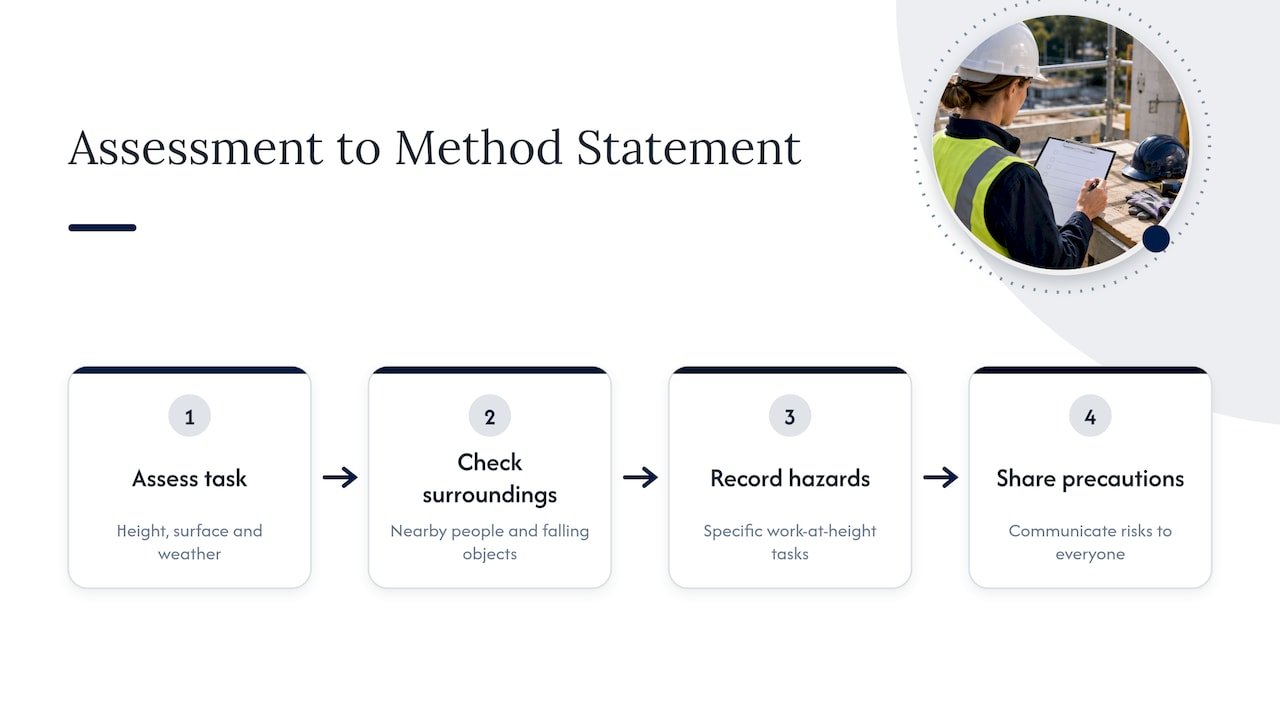
A good assessment names the task, the height, the surface, the weather, who else is nearby and what could fall. HSE describes a method statement as a useful way to record the hazards of specific work at height tasks and to communicate the risks and precautions to everyone involved. Keep it short enough that a supervisor will actually read it out at the start of a shift.
On construction projects the paperwork has a wider frame. The documents that sit around site safety planning are laid out in this overview of CDM paperwork for site compliance, which is a sensible companion when your work at height sits inside a notifiable project.
Who is competent
Competence means training, experience and the authority to stop work. In the US, OSHA guidance expects frequent and regular inspections of job sites, materials and equipment by competent persons, and allows only employees qualified by training or experience to operate equipment. The principle travels well: someone on site must be able to spot a defect and have the standing to act on it.
Contractors
You cannot hand the risk to a subcontractor with a clause. OSHA has warned that simple check-the-box contract language is often insufficient for judging whether a contractor can really do height work safely. Ask to see their method statement, their rescue arrangements, their equipment inspection records and the training of the people who will turn up.
Equipment, inspection and fall protection
Choose equipment for the task, not for habit. A short comparison:
| Control | Type | Protects | Main weakness |
|---|---|---|---|
| Permanent guardrail or edge protection | Collective | Everyone in the area | Needs to be in place and maintained |
| Scaffold or working platform | Collective | Everyone on the platform | Needs competent erection and inspection |
| Mobile elevating work platform | Collective | Operator and passengers | Needs trained operators and level ground |
| Work restraint | Personal | The wearer | Relies on correct adjustment and anchor |
| Safety nets, airbags | Mitigation | People who fall into them | Fall still happens; needs correct rigging |
| Personal fall arrest | Mitigation | The wearer | Needs anchor, clearance, skill and rescue |
Thresholds elsewhere
If you manage sites in several countries, note that numeric triggers differ. Under US OSHA rule 1910.28(b)(1)(i), an employee on a walking-working surface with an unprotected side or edge 4 feet or more above a lower level must be protected by guardrails, safety nets or a personal fall protection system. In New Zealand, WorkSafe recommends that any potential fall greater than one metre is managed with physical barriers or fall restraint. Safe Work Australia explains that duty holders must, so far as is reasonably practicable, keep workers safe, consult them and coordinate with other duty holders, with the model regulations setting out duties for managing falls.
Mexico takes a permit-style approach. NOM-009-STPS-2011 requires written authorisation for tasks involving towers, suspended scaffolds or elevation platforms, granted only after the safety measures are checked. It also requires maintenance records for work at height systems to be kept for at least a year, and workers must tell their employer about any physical condition or fear of heights that could compromise safety.
In Great Britain, you will not find a single height trigger in the guidance. The hierarchy applies to the task, as above.
Falling objects and other hazards
People below are at risk too. OSHA highlights that communication tower climbers face falling objects, equipment failure and structural collapse as well as falls. Use toe boards, tool lanyards, exclusion zones and netting, and keep the ground area clear.
Rescue planning: the part most plans skip
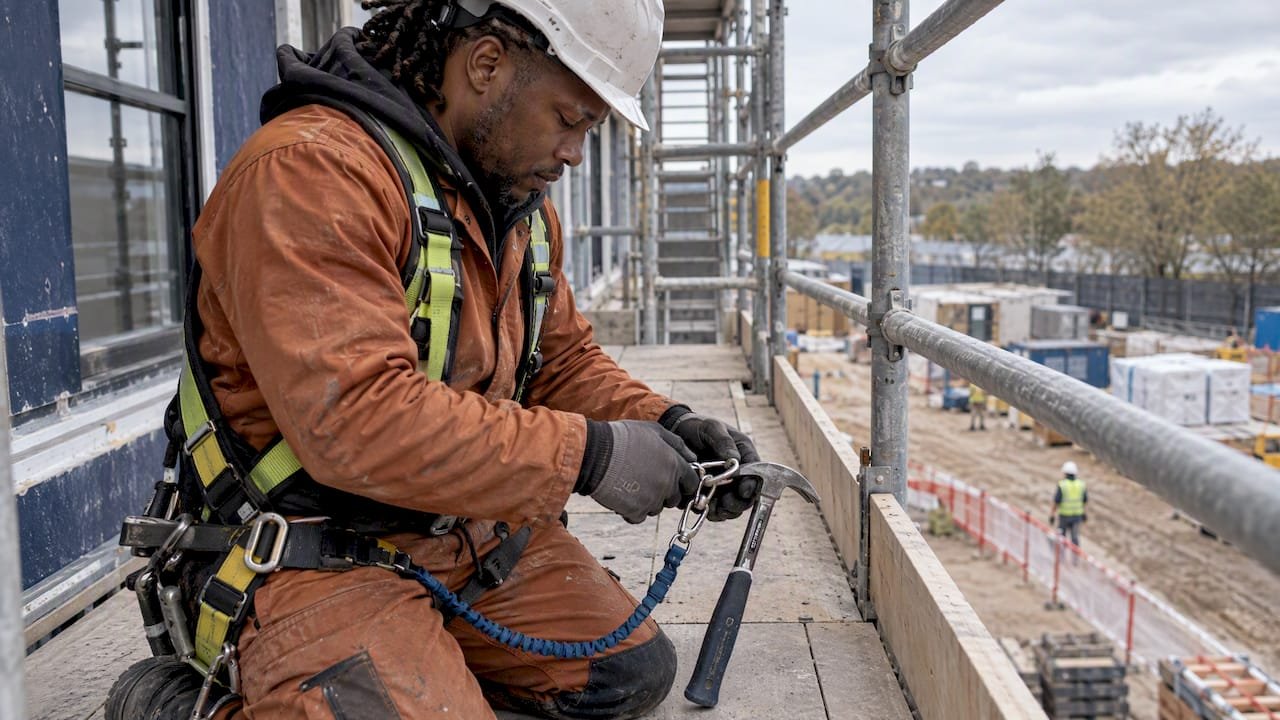
If you use personal fall arrest, the fall is only the start. OSHA states that when these systems are used, employers need a rescue plan and rescues must be carried out promptly and safely.
Time matters because a person hanging in a harness can develop suspension intolerance. WorkSafe New Zealand’s rope access guidance notes that industry practice is to rescue a person at risk within 10 minutes so they are no longer suspended in the harness. The same guidance warns that a rescue plan must account for added hazards to the rescuer, including the speed of descent and whatever caused the casualty’s initial problem.
In practice, a rescue plan answers five questions before the job starts:
- Who is trained and on site to carry out the rescue?
- What equipment is available, and is it inspected and within reach?
- How is the emergency service called, and how are they directed to the exact spot?
- What will you do about someone who is conscious but suspended?
- Has the plan been rehearsed, not just written?
For a fuller view of the equipment and records that support this, safety document control is worth a read when you are tightening how inspection and compliance records are kept.
Training that actually changes behaviour
Training is a legal expectation and a practical one. OSHA standards require that worker training is delivered in a language and manner employees can understand. That is a good test for any site, including UK sites with multilingual crews and agency labour.
Useful training for height work usually covers:
- The hierarchy of control and why harnesses come last.
- How to inspect, fit and store equipment, and when to quarantine it.
- Safe use of ladders, stepladders, platforms and scaffolding.
- Fragile surfaces and edge work.
- Emergency and rescue procedures, practised on site.
- Reporting near misses and stopping work.
Refresher training matters as much as the first course. Complacency builds when nothing goes wrong for months, and equipment changes, so skills need topping up.
A working at height checklist
Victoria’s WorkSafe pocket guide for construction safety suggests a working-at-height checklist should cover whether the work can be done from the ground, fall prevention controls, planning and precautions, training and dropped-object prevention. Here is that structure made practical for a UK site.
Before the task
- Can the work be done from the ground or from an existing safe place?
- Has a risk assessment been completed for this task and this location, and a method statement written where needed?
- Is the surface sound? Are fragile roof lights or deteriorated areas identified and protected?
- Is the equipment right for the task, undamaged, and inspected by a competent person?
- Are the people doing the work trained for this equipment, and are they fit to work at height?
- Is a rescue plan in place, with named people and equipment?
- Has weather been checked, including wind and rain?
During the task
- Has everyone been briefed on the method statement?
- Are guardrails, platforms and ladders set up on stable, level ground and not overloaded?
- Are tools and materials secured against falling, and the area below controlled?
- Is a competent person supervising, with authority to stop work?
- Are other trades kept away from the exclusion zone?
After the task
- Is equipment inspected, cleaned and stored properly, and defects reported?
- Are inspection and maintenance records updated?
- Were there near misses to learn from before the next shift?
Our perspective
We see the same pattern when we design safety and compliance programmes with organisations: the equipment is rarely the weak point. The weak point is the gap between the plan on paper and what a team does at 7am on a wet roof. A harness issued without a rescue plan, a method statement nobody reads out, a supervisor who does not feel able to stop the job.
Our advice is to train to your own sites, not to a generic syllabus. Use your actual access equipment, your actual edge conditions and your actual rescue arrangements, and then test them. Include supervisors and managers, not just the people who climb, because the decisions that matter most are made before anyone leaves the ground. We also suggest reviewing the hierarchy honestly each time: if the first answer is always a harness, the design or planning step is being skipped.
This is why we build programmes that can run on site, online or blended, so that the theory is covered once and the practical session happens where the risk actually is.
— Sam
Safety training built around your sites
If you need to upskill a team on height safety, compliance or wider workplace safety, we create customisable professional training that can be delivered on site, online or blended, with globally accredited qualifications and expert trainers who work from real-world challenges rather than slides. You can see how we work across the country on our London training centre page, or start from our main site and tell us what your team needs.

We also run training in other cities, so a multi-site employer can plan consistent sessions rather than relying on one-off courses.
FAQ
What is the definition of working at height?
It is any work where a person could fall and be hurt, whether above or below ground level. That includes work next to an open pit or fragile surface as well as work on a roof or ladder. There is no safe minimum height to rely on, so each task needs assessing.
What comes first when planning work at height?
Avoid it. HSE’s order is to avoid the work, use an existing safe place, use equipment that protects everyone, use work restraint and only then mitigate a fall. Personal fall arrest should not be your first answer.
Do I need a rescue plan if I use a harness?
Yes. OSHA states that employers using personal fall arrest systems need a rescue plan, and that rescues must be prompt. Rope access guidance in New Zealand points to around 10 minutes as the target for getting a suspended person out of the harness, so the plan must be rehearsed and equipment must be close.
Are the rules the same in every country?
No. The US sets a 4 foot trigger for protection on walking-working surfaces, New Zealand recommends managing falls greater than one metre, and Mexico requires written authorisation for certain tasks. In Great Britain, HSE guidance applies the hierarchy to the task, so always check the rules where the work happens.
What should a working at height checklist include?
Ask whether the work can be done from the ground, what fall prevention controls are in place, whether planning and precautions are written down, whether workers are trained, and how dropped objects are prevented. Add rescue arrangements and equipment inspection records.
Sources
- Working at height in New Zealand, WorkSafe New Zealand
- Assessing all work at height, HSE
- Working at heights, SafeWork NSW
- Working at heights, Safe Work Australia
- 1910.28 Duty to have fall protection, OSHA
- Letter to Communication Tower Industry Employers, OSHA
- Fall Prevention Student Workbook, OSHA
- Protecting Roofing Workers, OSHA
- Industrial rope access in New Zealand: best practice guidelines, WorkSafe New Zealand
- NOM-009-STPS-2011, Mexico
- The pocket guide for construction safety, WorkSafe Victoria