
No single rule says “everyone must hold an H2S certificate”. In the UK, the duty sits with the employer: assess the risk from hydrogen sulphide, control it, and make sure people are trained and competent for the work they will do. What counts as enough training depends on the site, the job and the industry standard your client or operator applies. This guide sets out what that means in practice, how awareness differs from hands-on courses, and how to keep a team compliant.
TL;DR
- There is no one universal H2S certificate. Employers must show training is adequate for the hazard, and industry bodies and clients set the detail.
- Awareness training teaches you to recognise the hazard. Hands-on courses add detection equipment, breathing apparatus and rescue. Match the level to the role.
- OPITO Basic H2S Training certificates stay valid for 2 years, so renewals need tracking.
- Training is one control among several. Gas detection, ventilation, a contingency plan and rehearsed drills matter just as much.
- Never rely on smell. H2S deadens the sense of smell, sometimes before a worker realises there is a leak.
Table of Contents
- Why H2S training is treated so seriously
- Where H2S shows up
- What the UK expects of employers
- Industry standards that set the detail
- H2S awareness or hands-on H2S training?
- What good H2S training covers
- Training is not the same as competence
- Respiratory protection is a separate requirement
- Detection comes before training
- Perspective: how we would build an H2S programme
- A practical plan for HR and safety managers
- Booking training for a team
- FAQ
- Sources
Why H2S training is treated so seriously
Hydrogen sulphide is a colourless, flammable, corrosive gas that smells of rotten eggs at low levels. The danger is that people can lose their ability to smell it, even at low concentrations, a condition called olfactory fatigue. At higher concentrations the effect is fast, so a worker who thinks “the smell has gone, so it is safe” may be in the most dangerous position of all. The HSE’s offshore COSHH guidance on hydrogen sulphide makes the same point, and any course worth taking should hammer it home.
It also explains why the requirements read as they do. Regulators care less about a piece of paper than about whether people will behave correctly when the alarm sounds.
Where H2S shows up
Most people link H2S with oil and gas, where sour crude and gas, drilling, refining and storage are the obvious sources. It is not limited to them. Hydrogen sulphide also turns up in:
- sewers, wastewater treatment and pumping stations
- slurry storage and handling on farms (the HSE’s slurry guidance says to always assume gases will be released in high concentrations)
- confined spaces such as tanks, pits and manholes
- some chemical, paper and food-processing sites
If your risk assessment says H2S could be present, even occasionally, the training question applies to you.
What the UK expects of employers
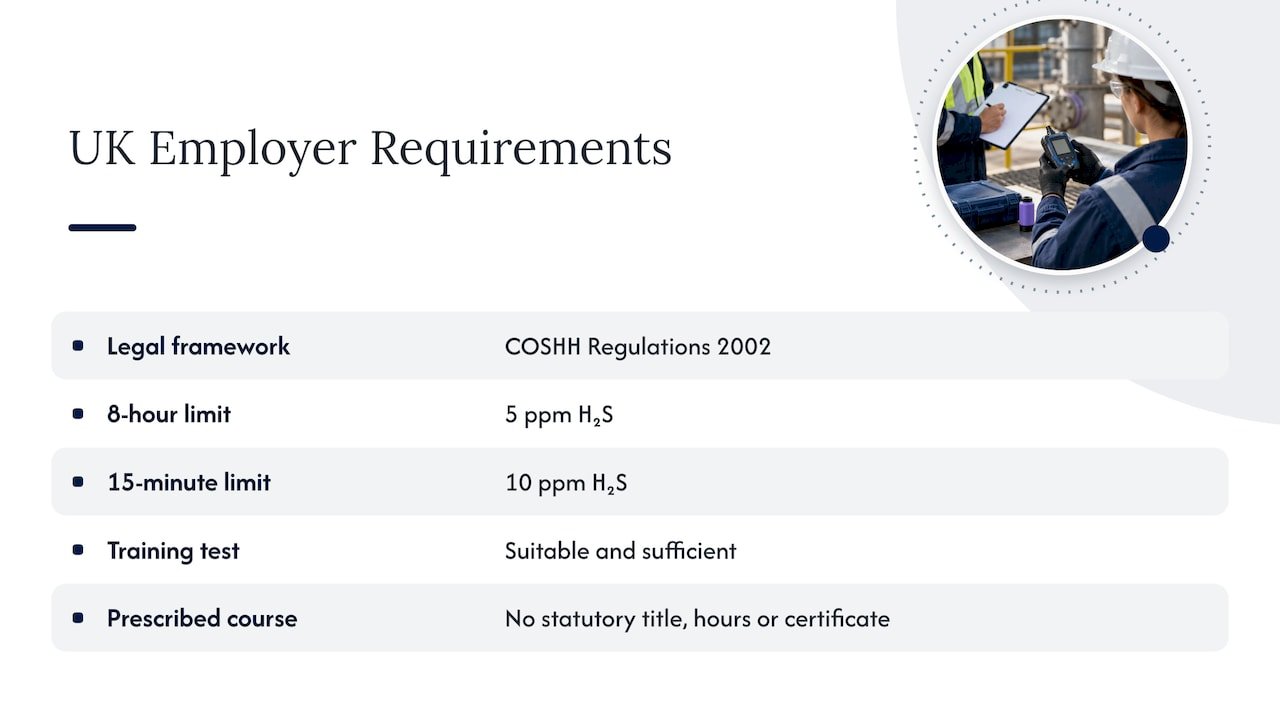
In Great Britain, H2S is handled under the Control of Substances Hazardous to Health Regulations 2002 (COSHH). The HSE’s offshore guidance is written to help dutyholders comply with COSHH and protect workers’ health. The logic applies onshore too. You assess the risk, put controls in place, and give people the information, instruction and training they need.
Two numbers help you judge how serious the exposure risk is. The 2018 edition of the HSE’s EH40 table lists hydrogen sulphide at 5 ppm as an eight-hour limit and 10 ppm over 15 minutes. Limits are reviewed from time to time, so check the current EH40 edition before you quote them in a risk assessment.
Notice what is missing: a statutory course title, a fixed number of hours or a named certificate. UK law asks whether your training is suitable and sufficient. That is why clients, operators and industry schemes fill the gap with their own expectations.
Industry standards that set the detail
Offshore oil and gas: OPITO
For the offshore energy sector, OPITO publishes the standard most employers and operators recognise. Its Basic H2S Training standard is for personnel who are, or could be, working in an environment that could become contaminated by H2S gas. Certificates are valid for 2 years. Other offshore safety standards run on different cycles: the Minimum Industry Safety Training standard, for instance, is valid for 4 years.
Two practical points from the standard catch out workforce planners:
- Renewal timing. If a renewal course is completed within 3 months before the existing certificate expires, the new certificate is typically dated from the original expiry date, not the training date. Booking inside that window avoids losing time.
- Gas testing is a separate job. People who test atmospheres need more than awareness. OPITO sets out a separate Authorised Gas Tester training standard covering the initial training and knowledge assessment for that role.
United States: OSHA and ANSI/ASSP Z390.1
If your team works in the US or for a US operator, the picture is different. There is no single federal H2S training statute. OSHA relies on the general duty to provide a safe workplace, and employers use consensus guidance to decide what adequate training looks like. The key document is ANSI/ASSP Z390.1, which sets minimum requirements for site-specific hydrogen sulfide training programmes. The 2024 edition is the current benchmark for content, covering properties, sources, detection, protective equipment, rescue techniques and instructor qualifications.
OSHA also sets exposure limits. For general industry, exposure must not exceed 20 ppm as a ceiling, with a limited exception for a short peak. Note that US and UK figures differ, so quote the one that belongs to the jurisdiction you work in.
Other regions
Gulf, Asian and Australian operators often write their own H2S requirements into contracts, frequently referencing OPITO or an equivalent. If you send people abroad, ask the host operator for its training matrix before you book anything.
H2S awareness or hands-on H2S training?
This is the question behind many searches, usually phrased as awareness versus H2S Alive. Course names vary between providers, so look at what a course covers rather than its title. As a general guide:
| Awareness | Hands-on / practical course | |
|---|---|---|
| Typical length | Short, often a few hours or less | Longer, often a full day or more |
| Teaches | Properties, health effects, warning signs, alarms, evacuation | Everything in awareness, plus detector use, breathing apparatus, rescue |
| Best for | Visitors, office-based staff on site, contractors with low exposure risk | Operators, maintenance crews, emergency response and anyone who may need to act during a release |
| Delivery | Often e-learning or classroom | Practical, face to face |
| Assessment | Knowledge test | Knowledge test plus demonstrated skills |
The length of each is a provider convention, not a legal figure. Your site rules decide the minimum, and a client contract may be stricter than either.
A useful rule: if someone could be expected to put on breathing apparatus, use a gas detector or help someone else, awareness alone will not do. If someone only needs to know what to do when an alarm sounds and which way to walk, awareness may be enough, provided your site rules agree.
What good H2S training covers
Whichever level you choose, check the syllabus against this list. It follows the content areas in the standards above.
- Properties and sources: what H2S is, where it comes from on your site, and why it behaves as it does.
- Health effects: exposure symptoms at different concentrations, and why smell is not a warning system.
- Detection: fixed and personal monitors, alarm set points, bump tests and calibration.
- Protective equipment: when breathing apparatus is needed, how to don and check it.
- Emergency response: alarms, muster points, wind direction, evacuation routes and the rule not to rush in unprotected.
- Rescue techniques: only for roles that need them, and always practised.
- Site-specific content: your contingency plan, your equipment, your hazards.
A generic course cannot cover the last point. Z390.1 is built around site-specific programmes for exactly that reason.
Training is not the same as competence
A certificate shows someone attended and passed an assessment. Competence is the ability to do the right thing under stress, and it fades without practice. HSE guidance repeatedly stresses that training is one part of a wider system, alongside risk assessment, engineering controls and emergency arrangements.
Teams that treat the course as a box-ticking exercise tend to struggle when it matters, because people have never rehearsed with the equipment they will actually wear. In practice that means:
- Run drills at least as often as your risk assessment says, and more often after staff changes.
- Practise donning breathing apparatus until it is quick and automatic.
- Test alarms and evacuation routes with the whole shift, including contractors.
- Record who took part, what went wrong and what changed afterwards.
Respiratory protection is a separate requirement
Many H2S courses include basic equipment awareness. That does not replace specific respiratory protection training or fit testing for the equipment on your site. In the US, OSHA’s oil and gas guidance on H2S sits alongside the respiratory protection standard, 29 CFR 1910.134. A general H2S certificate does not automatically satisfy site-specific obligations for respiratory equipment or its maintenance. In the UK, check the equivalent through your COSHH assessment and your equipment supplier’s instructions.
Detection comes before training
Training cannot stand in for engineering controls. Ventilation, gas detection and safe systems of work come first, and training helps people use them. OSHA’s fatal facts material on a hydrogen sulfide release makes a related point: monitoring should be in place before entry, not started once someone suspects gas is present. If H2S is even potentially present, personal monitors belong in the kit of every employee and visitor going in.
Perspective: how we would build an H2S programme
We train organisations across safety, compliance, oil and gas, healthcare and engineering, and the same pattern turns up on every safety programme. Teams buy a course to satisfy a client, tick the box, and then discover the gap between certificate and capability on the worst possible day.
Our view is simple. Start from the risk assessment, not the course catalogue. Decide which roles face which level of exposure, then match the training level to the role. Send the awareness group through the shorter route and put the people who may have to act through practical training. Then close the loop with drills on your own equipment and your own site.
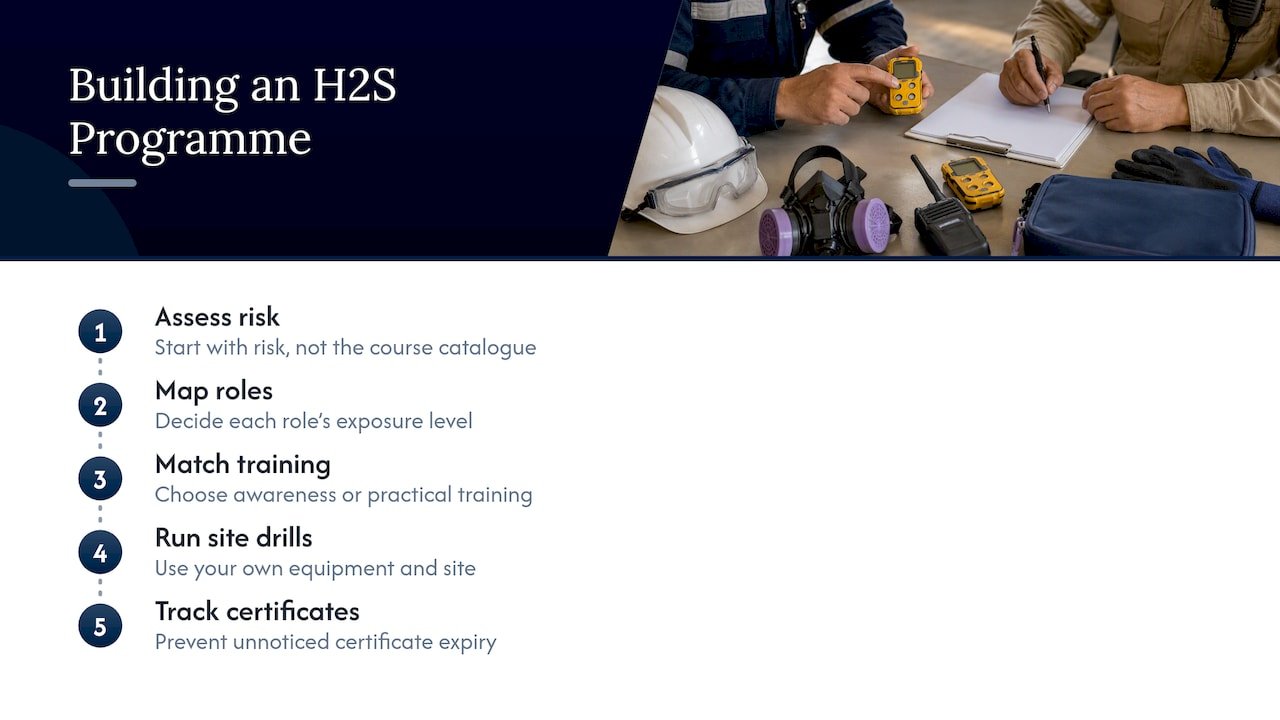
That is where customisation matters. A generic public course teaches the properties of the gas well enough. It cannot teach your alarm set points, your muster points or your contingency plan. We build programmes that can run on site, online or blended, so awareness content can be delivered efficiently to a large group while practical sessions happen where your people actually work.
And track the dates. A certificate that lapses unnoticed is a compliance problem, and it can stop a crew mobilising.
— Sam
A practical plan for HR and safety managers
- List the roles. Note who works where H2S could be present, who may need to respond and who only visits.
- Check the requirement source. Ask: does a client, operator, insurer or industry scheme specify a course or standard?
- Match level to role. Awareness for low-exposure roles, practical training for responders and operators, gas tester training for those who test atmospheres.
- Check the provider. Is the syllabus aligned with the standard you need, are instructors qualified, and does the certificate come from a recognised scheme?
- Add site-specific content. Cover your contingency plan, detectors and equipment.
- Diarise expiry. For OPITO Basic H2S Training, that is 2 years, with the 3-month renewal window in mind.
- Drill and record. Keep attendance, findings and corrective actions.
Booking training for a team
If you are planning safety and compliance training for a group, we can help you scope it around your sites and roles, with on-site, online or blended delivery. You can see where we run courses in London, Bristol and Houston, or start from the Oxford Centre home page and tell us what your risk assessment requires.
FAQ
Is H2S training a legal requirement in the UK?
There is no UK law naming a specific H2S certificate. However, COSHH requires employers to assess the risk and give workers suitable information, instruction and training, and where H2S is a foreseeable hazard that effectively means formal training. Many clients and operators also make a named course a condition of site access.
Can you take H2S training online?
Awareness-level content is commonly delivered online, and many providers offer it as e-learning. Practical elements such as breathing apparatus and rescue need to be done face to face. Check what your client or scheme accepts before choosing an online-only route.
How long does an H2S certificate last?
It depends on the scheme. OPITO Basic H2S Training certificates are valid for 2 years. Other providers and operators set their own refresh periods, and some require annual training, so confirm with the body that sets your requirement.
Can you rely on smell to detect H2S?
No. H2S can deaden the sense of smell, so a worker may stop noticing it while the concentration rises. Detection must come from calibrated gas monitors, not from noses.
Sources
- OSHA Fatal Facts: Hydrogen Sulfide Release
- HSE Offshore COSHH essentials OCE6: Hydrogen sulphide
- HSE: Managing slurry on farms (AIS9)
- HSE EH40/2005 Workplace exposure limits (2018 edition)
- OPITO: Basic H2S Training
- OPITO: Authorised Gas Tester Training Standard
- ASSP: ANSI/ASSP Z390.1 Hydrogen Sulfide Training Standard
- ANSI Blog: ANSI/ASSP Z390.1-2024
- OSHA: Hydrogen Sulfide Standards
- OSHA eTool: H2S Safety and Health Hazards