
Construction safety training in Britain is a ladder, not a single course. Operatives start with a short awareness course and a site induction. Supervisors move up to a two-day scheme, and site managers to a five-day one. The law does not name one certificate. It requires that every person on site is trained and competent for the work they are given. This guide sets out who needs what, how inductions and CSCS cards fit in, and how to plan training so it holds up on site and not just on paper.
TL;DR
- UK employers must train workers on recruitment, on transfer, and when new risks or equipment arrive. That training must happen in working hours.
- The usual CITB ladder is a 1-day Health and Safety Awareness course, a 2-day SSSTS for supervisors and a 5-day SMSTS for site managers.
- A site induction is separate from a certificate. It covers the specific hazards, rules and emergency arrangements of one site.
- Most CSCS cards need a qualification plus a pass in the CITB Health, safety and environment test.
- Choose training by role and by the risks your sites actually carry, then keep it current. Competence has to be maintained.
Table of Contents
- What construction safety training covers
- The legal duty behind it
- The course ladder: who needs what
- Site induction: what it must do
- CSCS cards and the health, safety and environment test
- Funding and cost planning
- Choosing training for your team
- Our perspective: training that changes behaviour
- How Oxfordcentre can help
- Working outside the UK
- FAQ
- Sources
What construction safety training covers
The phrase covers three different things, and mixing them up is the commonest planning mistake.
- Awareness and role training. Short, recognised courses that give a worker or manager the baseline knowledge for their role.
- Site-specific induction. A briefing on one project: access routes, welfare, permits, emergency procedures, live hazards.
- Task and trade competence. Skills and tickets for particular work, such as scaffolding, plant operation or working at height.
A certificate answers the first. An induction answers the second. Only supervision, experience and assessment answer the third. A site manager asking for “safety training” usually needs all three in sequence.
The legal duty behind it
The starting point is regulation 13 of the Management of Health and Safety at Work Regulations 1999. It requires employers to give employees health and safety training on recruitment, when they are transferred or change responsibilities, and when new equipment or new risks are introduced. The training must take place during working hours. That last point matters for budgeting: you cannot expect people to complete it on their own time.
On construction projects, competence is a defined idea, not a vague compliment. HSE guidance describes it as a combination of training, skills, experience and knowledge, and says it must be kept up to date. The wording in the HSE publication we checked sits in its guidance on quarries, but the principle it states is the same one HSE applies across industries: training contributes to competence, and competence is not a one-off achievement. Managers are expected to spot gaps through regular monitoring and accident investigation.
Two practical consequences follow:
- You cannot hire an outside expert to be “the competent person” for your whole operation. As an employer you coordinate, and each worker must be demonstrably competent for the task they are given.
- A certificate that is five years old, for a worker doing work that has changed, proves less than it appears to.
Plans should be proportionate
Training feeds into planning documents such as the Construction Phase Plan. HSE’s CDM guidance says a plan should be proportionate to the size and scale of the job. Over-engineered paperwork on a small project can bury the few controls that matter. Good training teaches people to read a short plan and act on it.
The course ladder: who needs what
CITB-supported courses give the most widely recognised route. The durations below come from CITB’s list of health and safety courses supported through Employer Networks (February 2026).
| Role | Typical course | Duration | What it is for |
|---|---|---|---|
| Operatives, new starters | Health and Safety Awareness (HSA) | 1 day | Core hazards and duties before working on site |
| Supervisors, team leaders, foremen | Site Supervision Safety Training Scheme (SSSTS) | 2 days | Supervising people and tasks safely |
| Site managers, project managers | Site Management Safety Training Scheme (SMSTS) | 5 days | Managing site safety, legal duties, risk and planning |
| Safety practitioners | NEBOSH-type qualifications | Varies by provider | Advising on and auditing safety across projects |
Prices vary widely by provider, format and region, so we do not quote a single figure. Ask for the total per delegate including exam and certificate fees, and check whether VAT is added.
Watch for prerequisites
Some advanced courses have entry requirements that catch planners out. The CITB listing for scaffolding part 2, for example, expects delegates to have at least six months of practical scaffolding experience after completing part 1. If your training budget runs across a year, map those waiting periods first, or a team member will be eligible for the next step months later than you assumed.
Site induction: what it must do
An induction is not a formality to get through before the first tea break. Done properly, it tells each person what is dangerous on this site, today, and what to do about it. Whatever the format, a useful induction covers:
- who is in charge and how to raise a concern;
- site layout, access and exclusion zones, including traffic and plant routes;
- welfare facilities and first aid;
- fire and emergency procedures, and where to assemble;
- the main live hazards: working at height, excavations, lifting operations, services, asbestos where relevant;
- permits, PPE rules and how the site manages its Construction Phase Plan.
Keep a signed record and repeat or top up the induction when conditions change, for instance when a new phase begins or a new contractor arrives. This ties straight back to the regulation 13 triggers: new risks mean new training.
Make inductions interactive
A lecture-only induction is the weakest option. The US safety regulator’s recommended practices for construction safety programmes argue for a find-and-fix approach, where workers take part in identifying hazards and choosing controls. The guidance is American, but the point travels well: people who help find the problem are more likely to follow the fix. A short walk of the site with new starters, asking them to spot hazards, does more than a slide deck.
CSCS cards and the health, safety and environment test
Many site operators ask for a CSCS card at the gate. For most cards, applicants need a construction qualification, or to be registered for one, and a pass in the CITB Health, safety and environment test or an approved alternative. The test is owned and run by CITB, not by CSCS. There are versions for operatives, specialists and managers and professionals.
Two points for HR and site managers:
- A CSCS card shows a worker has met a baseline. It is not an induction and it does not replace task training.
- Course certificates such as SMSTS are separate from the card. A manager may need both, so check what your client or principal contractor actually asks for.
Funding and cost planning
Employers registered with CITB can often claim support. Under the Employer Network arrangements, support for courses such as health and safety in construction site supervision reached up to £115 per achievement as of February 2026. The same document lists up to £600 per achievement for some short-period qualifications, such as Level 2+ NVQs or the NEBOSH National Certificate, for eligible trainees. Eligibility rules and rates change, so check the current grant terms before you commit.
CITB also runs a course finder for approved training, which is a sensible place to compare what is available in your area before approaching any provider.
A realistic budget for a contractor includes:
- course fees per delegate, plus exam fees;
- wages for the days off site, since training must happen in working hours;
- travel, if the course is not local;
- refresher costs, which recur;
- cover for the supervisor’s absence.
The wages line often exceeds the course fee on longer courses. That is the strongest argument for blended or on-site delivery, which cuts travel and lets you schedule around the programme.
Choosing training for your team
Start from the work, not the catalogue.
- List roles and tasks. Who supervises, who plans, who works at height, who operates plant.
- Identify the risks. Use your risk assessments and any incident or near-miss records, not guesswork.
- Check client and site requirements. Principal contractors often specify cards and certificates.
- Match to the ladder. Awareness for starters, SSSTS for supervisors, SMSTS for managers, specialist tickets for specific tasks.
- Add site-specific content. Where your risks are unusual, standard courses will not cover them. Look for training that can be tailored.
- Plan the refresh. Put expiry dates and refresher courses in a single tracker.
- Check on the ground. Observation and accident investigation reveal gaps that certificates do not.
Questions to put to any provider
- Is the course recognised by the body your clients or site operators accept?
- Who delivers it, and what site experience do they have?
- Can the content be adapted to our work, and can it be delivered on site?
- What happens after the course: assessment, certificates, refreshers?
Certification does appear to matter for outcomes. BCSP, the US certifying body, reports that construction personnel holding additional certifications were associated with an average TRIR decrease of 1.910. That is an association in US data, not a promise for any UK firm, but it supports investing in more than the minimum.
Our perspective: training that changes behaviour
We work with organisations in project management, civil engineering, oil and gas, healthcare, compliance and safety, so we see the same pattern across sectors. Teams rarely fail because nobody attended a course. They fail because the course was generic, the content never touched the real site, and nobody checked afterwards.
Our view is simple. Start with the risks your people actually face and build the programme around them. Use accredited qualifications where clients and regulators expect them, then add practical, expert-led content on top that reflects your sites, your equipment and your supervisors’ real decisions. Make delivery fit the work: on site, online or blended, depending on shift patterns and travel.
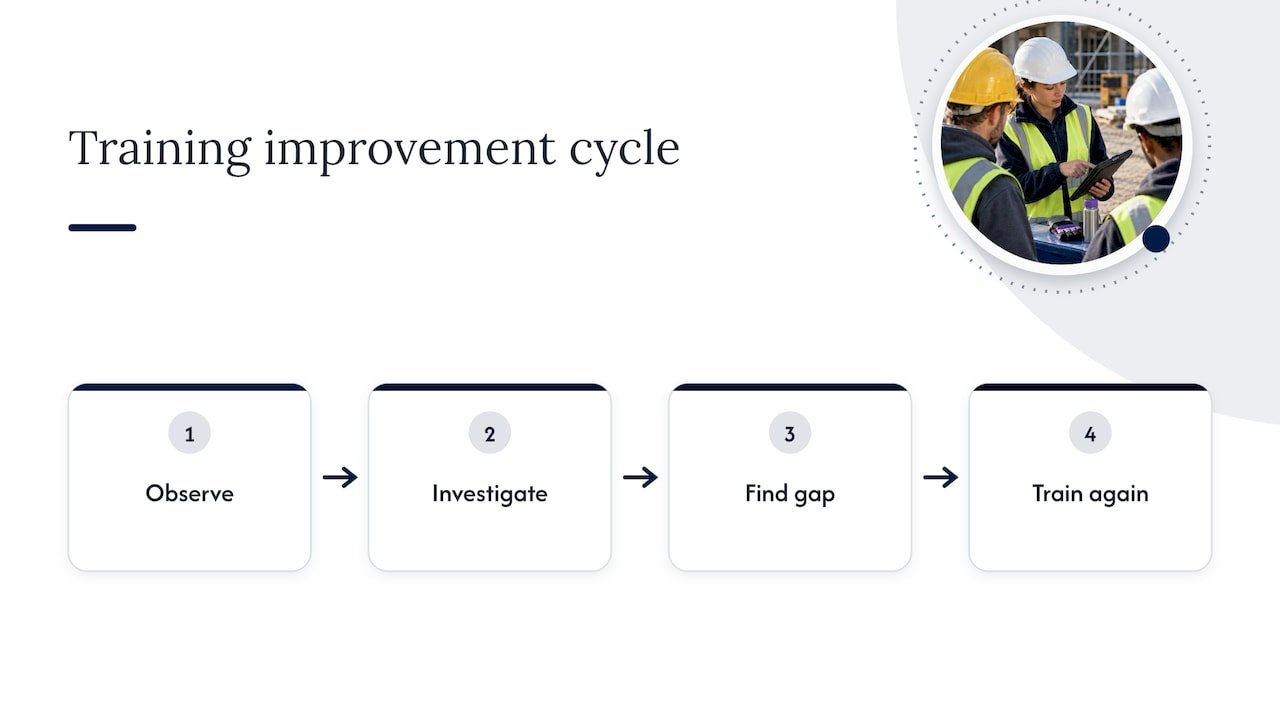
We also think managers should treat training as the start of a cycle. Observe, investigate, find the gap, train again. Competence that is not maintained decays, and regulators say as much.
— Sam
How Oxfordcentre can help
If you are planning safety, compliance or project-management training for a team, we build customisable programmes with globally accredited options, delivered on site, online or blended. You can see our project management training for managers who need to combine delivery and safety responsibilities, or browse professional training courses in London if you want a city-based option. For anything tailored to your sites, start from our home page and tell us the roles, risks and timetable. Please check which specific qualifications each programme carries before booking, so they match what your clients require.
Working outside the UK
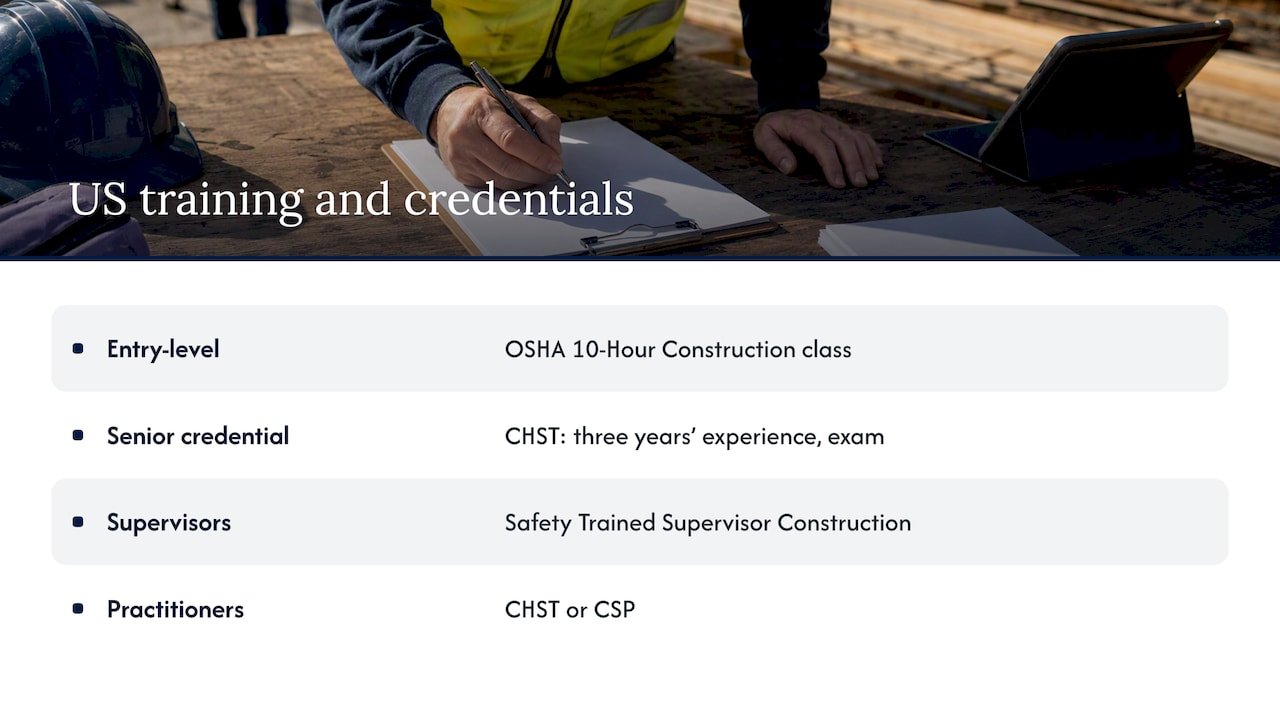
Requirements are national. In the United States, entry-level training commonly means the OSHA 10-Hour Construction class. Texas, for instance, describes it as a low-cost class offered in English and Spanish. Employer duties there follow 29 CFR 1926. Senior practitioners can pursue credentials such as the Construction Health and Safety Technician, which requires three years of construction safety experience and a professional exam. BCSP also explains that the right certification depends on role and career stage: supervisors suit the Safety Trained Supervisor Construction, while dedicated practitioners aim for the CHST or CSP.
If you run projects in several countries, do not assume a UK certificate satisfies a local regulator, or the reverse. Check the rules in each place of work.
FAQ
Is construction safety training a legal requirement in the UK?
Yes, in the sense that employers must give workers adequate health and safety training. Regulation 13 requires it on recruitment, on transfer and when new risks or equipment arrive, during working hours. The law does not name one certificate, but site operators often ask for specific ones.
What is the difference between a site induction and a safety course?
A course gives a worker or manager recognised, role-based knowledge and usually ends in a certificate. An induction covers one particular site: its hazards, rules, welfare and emergency arrangements. You need both, and the induction should be repeated when site conditions change.
Which course does a site manager need?
The widely used route is the 5-day Site Management Safety Training Scheme. Supervisors typically take the 2-day SSSTS, and new operatives the 1-day Health and Safety Awareness course. Confirm with your client or principal contractor what they accept before booking.
Do I need a CSCS card as well as a course certificate?
Usually, yes, if the site asks for one. Most CSCS cards need a construction qualification and a pass in the CITB Health, safety and environment test or an approved alternative. A course certificate such as SMSTS is a separate document.
Sources
- Management of Health and Safety at Work Regulations 1999, regulation 13
- HSE: L118 guidance on competence and training
- HSE: CDM 2015 frequently asked questions
- CITB: health and safety courses supported via Employer Networks, February 2026
- CITB: scaffolding part 2 course details
- CITB: find a course
- CSCS: booking a health and safety test for a CSCS card
- OSHA: recommended practices for safety and health programs in construction
- BCSP: workplace safety certification
- BCSP: Construction Health and Safety Technician
- BCSP: which certification is right for you
- Texas Department of Insurance: OSHA 10-Hour Construction class