
You qualify for the PMP exam if you have a secondary diploma plus 60 months, or a four-year degree plus 36 months, of non-overlapping project leadership, and 35 hours of project management training (or an active CAPM). PMI may audit your application. Once approved, you get one year and up to three attempts. Live training rules tighten on 1 December 2026.
TL;DR:
- Count only calendar months within the 10 years before applying; overlapping projects count once, and routine operations or work without professional leadership do not qualify.
- From December 1, 2026, live instruction must come from an approved provider or eligible academic program; aligned self paced courses remain acceptable from any provider.
- Training completed before December 1, 2026, remains eligible under earlier rules; keep course completion records because claimed hours must be traceable.
- If selected for an audit, submit proof of education, experience, and training by the handbook deadline; reviews take about 5 to 7 business days.
- For each project, record dates, title, role, average weekly hours, responsibilities, and outcomes; map descriptions to the people, process, and business environment domains.
Table of Contents
- What are the PMP eligibility requirements by education level?
- What counts as the 35 hours of project management training?
- How do you record projects, roles and dates on the application?
- How do PMP audits, eligibility periods and retakes work?
- What is the PMP exam format and what does it cost?
- How do you keep the PMP: PDUs and the three-year cycle?
- Our perspective: practical steps to meet the requirements
- How do you submit the PMP application step by step?
- Does PMI membership make PMP certification cheaper?
- Our editorial take: keep better records than you think you need
- How Oxford Center can help you secure qualifying training hours
- FAQ
- Sources
What are the PMP eligibility requirements by education level?
PMI sets out the education-to-experience combinations in the PMP Examination Content Outline, and every route also requires 35 contact hours of project management training. Match your education to a row below, then check your experience against it.
Check each figure against the current handbook before you submit, because PMI updates its pathways from time to time and the version in force on the day you apply is the one that counts.
How PMI counts your months
Experience is counted in calendar months, and only once. If you led overlapping projects, count only the elapsed calendar months once. PMI’s own certification pages make the same point: you must not double-count overlapping project months, and only the elapsed calendar months count towards your total, as stated on the PMP certification page.
The experience must also fall within the last 10 years before you apply. A project completed outside the eligibility period does not help, however senior your role was.
What counts as project experience
PMI wants evidence that you led and directed work in a professional setting. Here is how to sort your own history:
- Counts: projects with a defined start and end, where you directed tasks, managed a team or budget, or were accountable for delivery.
- Counts: projects in any industry, and roles that were not titled “project manager”, as long as you led the work.
- Does not count: personal or volunteer-style projects with no professional setting.
- Does not count: routine operations, such as running the same monthly process with no defined end.
- Does not count: work where you only contributed tasks and did not lead or direct others.
PMI also stresses that training and experience are separate tests. The 35-hour requirement builds foundational knowledge, while your experience demonstrates applied leadership of projects in a real-world setting. Strong training cannot make up for missing months, and long experience cannot replace the training hours.
If you are unsure which of your projects qualify, look at it from the reviewer’s side. A reviewer wants to see a project with a clear beginning and end, a named role that carried responsibility, and tasks that map to the people, process and business environment domains in the outline. If a project fails any of those three tests on paper, it will be hard to defend in an audit, even if you know the work was real. Leave it out and count it only if you have no better alternative.
Project leaders who want to sharpen how they describe their responsibilities may find this playbook on structuring project teams useful, since the application rewards clear statements of who you led and what you were accountable for.
What counts as the 35 hours of project management training?
The 35 hours are contact hours of instruction in project management, and they must align with the current PMP Examination Content Outline. They are not the same as PDUs, which you earn after certification to keep it. PMI’s guidance on meeting the 35-hour requirement covers what qualifies in detail.
Typical qualifying sources include:
- PMI Authorized Training Partners (ATPs)
- PMI GAC accredited academic programmes
- Employer-sponsored training that covers the outline content
- Third-party training providers that include an assessment
- Self-paced courses with an end-of-course assessment and a completion record
You can combine hours from several courses to reach 35, as long as each one is relevant and documented. Keep every certificate, because the hours you claim must be traceable.
The CAPM waiver
If you hold an active Certified Associate in Project Management (CAPM), the 35-hour requirement is waived. An expired CAPM does not count, so check the status of your certificate before you rely on it.
The 1 December 2026 change
PMI has announced an update to the exam effective 1 December 2026, set out on its page about the updated PMP exam. From that date, live instructor-led training qualifies only if a PMI Authorized Training Partner, a China Registered Education Provider or an eligible accredited academic programme delivers it. Self-paced on-demand courses remain acceptable from any organisation, provided they align with the outline. Training you complete before 1 December 2026 remains eligible under the earlier rules.
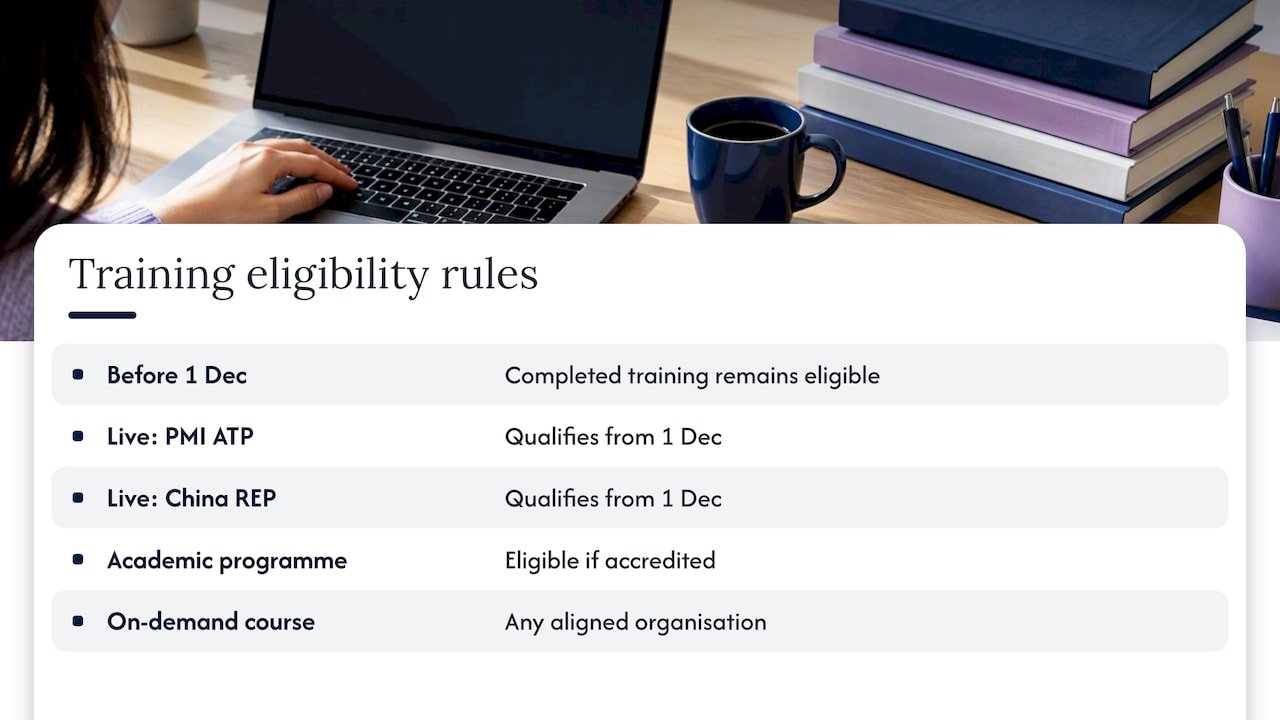
Pro Tip: If you plan to take a live course, check the provider’s PMI status before you pay. A course that qualified last year may not qualify once the new rules apply.
How do you record projects, roles and dates on the application?
The online application asks you to describe each project in enough detail that a reviewer can see you led it. Work through it in this order:
- Write down every project you intend to claim, with its start and end month.
- Remove overlaps so each calendar month is counted once.
- For each project, enter the title, your role, the dates and your average hours per week.
- Describe your tasks and outcomes in terms that map to the outline’s domains.
- Add up your months and confirm they meet your education pathway.
PMI notes that the application requires you to document specific project roles, responsibilities and outcomes, and that it is intentionally demanding to protect the credential’s value, as described on the PMP certification process page.
A worked example with overlapping projects
For example, if two projects overlap during the same year, enter both projects but count each elapsed calendar month only once.
Evidence to keep
Store these in one folder, digital or paper, from the day you start the application:
- Course completion certificates and syllabi for your 35 hours
- Degree certificates or transcripts
- Employer letters or references confirming your role and dates
- Project documents that show your responsibilities, such as charters or plans
Name files clearly, for example “ProjectA_EmployerLetter”, so you can find them quickly if PMI asks.
How do PMP audits, eligibility periods and retakes work?
PMI audits a share of applications to confirm that what you declared is accurate. The Certification Handbook explains the process. If selected, you are asked for evidence of your education, your experience and your training hours.
Applicants should check the Certification Handbook for the deadline to submit audit materials. Once submitted, the audit should take about 5 to 7 business days to complete.
Selection is not a judgement on you, and an audit does not mean you did anything wrong. Treat the possibility as a reason to prepare, not to worry.
Preparing an audit package
- Signed verification for each project from a supervisor or colleague who can confirm your role
- Copies of your degree or diploma
- Certificates for every training course counted towards the 35 hours
- A single summary sheet listing projects, dates and months claimed
Because the documents arrive in one go, a tidy package avoids follow-up requests that slow the audit down.
The eligibility period and the three-attempt limit
Once PMI approves your application, check the Certification Handbook for the current eligibility period and exam-attempt rules, and plan your study schedule accordingly.
What is the PMP exam format and what does it cost?
The PMP exam is made up of scenario-based questions drawn from the Examination Content Outline. Rather than recall definitions, you are asked what a project leader should do in a realistic situation. Check the outline for the current number of questions, time allowed and domain weightings before you start studying, because PMI revises them with each update.
- Content: questions map to the domains and tasks in the outline, so use it as your study checklist.
- Delivery: you can usually sit the exam at a test centre or online with a remote proctor. Pearson VUE describes how online proctoring and ID checks work for remotely proctored PMI exams.
- Check-in: bring valid identification that matches the name on your application exactly. A mismatch can stop you from sitting the exam.
- Fee: payment comes after PMI accepts your application, and PMI member pricing applies if you have joined. Always confirm current fees on PMI’s website before you pay.
Practise with scenario questions rather than memorising lists. The exam rewards judgement, so work through why each wrong answer is wrong, not just which answer is right. If you choose online proctoring, run the system test on your own computer in advance and clear your desk, because technical or environmental problems on the day can cost you an attempt.
How do you keep the PMP: PDUs and the three-year cycle?
Passing the exam is not the end of the commitment. To keep your credential, earn the required professional development units (PDUs) during each renewal cycle, as described on the PMP certification page. PDUs are different from the 35 training hours: they reward learning and contribution after you are certified.
Common ways to earn them include:
- Attending webinars, courses or conferences on project management
- Reading, writing or presenting on the profession
- Mentoring others or volunteering for a professional body
- Applying your skills through work on projects
A simple plan is to spread your PDU activity across the renewal cycle, so you avoid a last-minute rush.
Pro Tip: Log each PDU in your PMI account on the day you earn it, with the date and a short note, so renewal is a matter of reviewing your record, not reconstructing it.
Our perspective: practical steps to meet the requirements
At Oxford Center we see the same application errors again and again: months counted twice, vague role descriptions and missing certificates. Careful records solve most of them, and a training provider that issues clear completion documents makes an audit far easier to answer. Our accredited courses run on site, online or blended. You can read more about our training centre and the project careers we support, including our coverage of APM’s call for project careers.
How do you submit the PMP application step by step?
The submission itself is straightforward if your records are ready.
- Create or sign in to your PMI account and start a new PMP application.
- Enter your education details and confirm the pathway that applies to you.
- Add each project with its dates, role and description, checking for overlaps.
- Record your 35 contact hours, or confirm your active CAPM.
- Review the whole application, then submit it.
- Wait for PMI’s response, which includes the possibility of an audit.
- Once approved, pay the exam fee and schedule your sitting.
Save a copy of your submitted application. If you are audited, it is the document your evidence has to match, line for line.
Does PMI membership make PMP certification cheaper?
PMI members pay a lower exam fee than non-members, and membership also gives access to study resources and the community. Whether it pays for itself depends on the fees in force when you apply, so compare the member and non-member exam price with the cost of joining before you commit. PMI’s main site lists current membership and exam pricing.
Membership has a further practical use: PDU opportunities and learning resources are easier to find once you belong, which helps in the three-year cycle after you pass. If you are certain you will sit the exam within the year, joining before you pay the exam fee is worth pricing out.
Our editorial take: keep better records than you think you need
The conventional advice is to chase the exam and treat the application as paperwork. We think that is backwards. The application is where most avoidable trouble sits, and the exam rewards the same habits: clear roles, tidy dates, evidence you can produce on request.
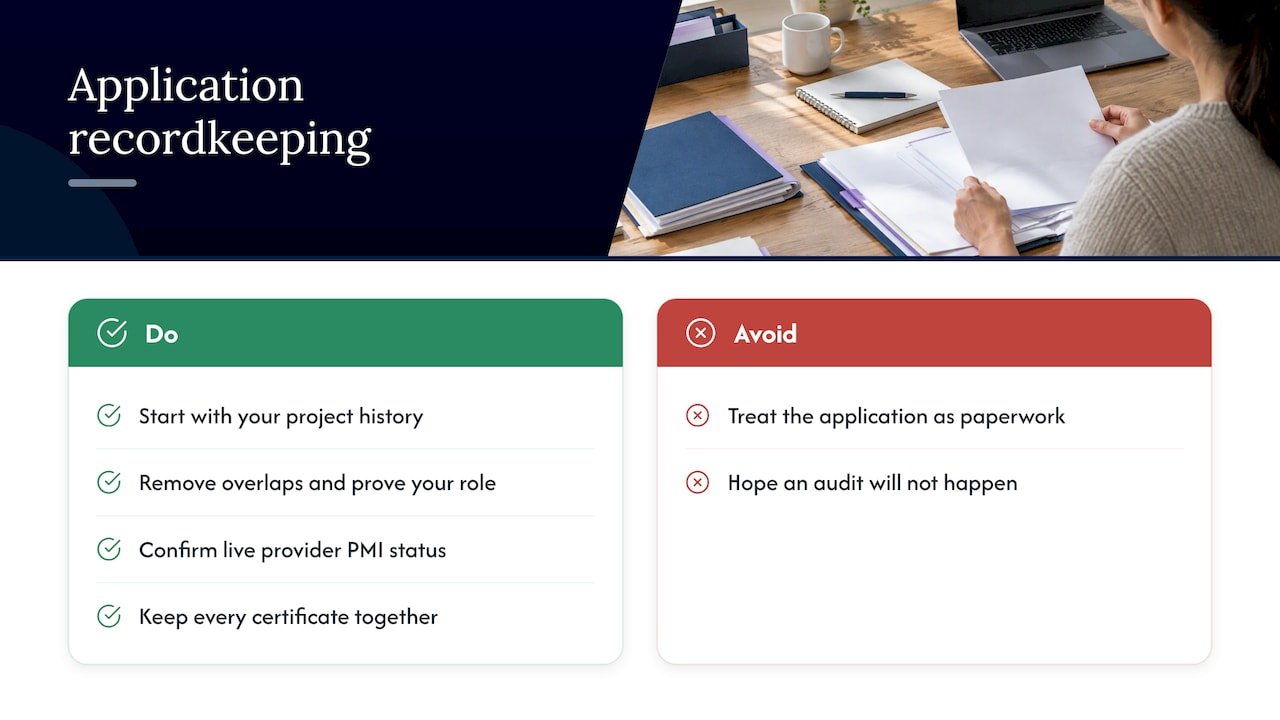
Start with your project history, not your study plan. Write each project down, remove overlaps and ask whether you can prove your role. Then look at your training. The 1 December 2026 change means a live course is only as good as its provider’s PMI status, so confirm that first. Self-paced courses with a proper assessment remain flexible, but only if you keep the completion record.
Rules like these shift, and providers sometimes describe them loosely. Rely on PMI’s own documents, keep every certificate in one place and treat an audit as a certainty to prepare for, not a risk to hope against.
— Sam
How Oxford Center can help you secure qualifying training hours
Our project management courses offer flexible on-site, online and blended delivery.
- Check that any course aligns with the PMP Examination Content Outline before you enrol.
- Keep your completion certificate for audit.
- Explore our project management courses or visit the Oxford Center home page to book for yourself or your team.
FAQ
What do I need to qualify for PMP?
You need the right mix of education and non-overlapping project leadership experience, plus 35 hours of project management training or an active CAPM. See the eligibility section above for the pathways by education level.
Is the PMP exam really hard?
It is demanding, because the questions are scenario-based and test judgement rather than recall. Candidates who study the Examination Content Outline and practise scenario questions prepare best. Third-party explainers also flag the difficulty and the need to maintain PDUs.
Can I pass PMP without training?
You still need the 35 hours of training to apply, unless you hold an active CAPM. Beyond that requirement, how much extra preparation you need depends on your experience and study habits.
Is PMP or PRINCE2 better?
Neither is better in general. They suit different roles and employers, so choose the one your sector and job market value most.