

IT and Computer Science Training Courses, in a corporate context, mean accredited, customisable programmes built for workplace roles, not university degrees or free consumer coding classes. The right approach is modular, instructor-led training with hands-on labs, mapped to real job tasks and tracked against measurable KPIs. Oxford Training Centre fits this brief directly, offering globally accredited courses across on-site, online and blended formats built for corporate teams rather than solo learners.
TL;DR:
- Customised training programs that are mapped to your organization’s specific tools and workflows improve engagement, retention, and faster adoption of new technologies.
- Accredited courses should be regularly updated to match current certification exam blueprints to ensure effective exam preparation and proven skill transfer.
- A structured pilot lasting 60 to 90 days with five to eight participants can reliably gauge course usability, lab stability, and real learning outcomes before full deployment.
- Vendors must provide live lab environments, flexible module options, and clear content refresh cycles to be considered trustworthy partners.
- Conduct a thorough training needs analysis and evaluate vendor expertise, instructional design, and LMS integration, rather than relying on price or fixed catalogues alone.
Table of Contents
- Why choose customised, accredited corporate IT training?
- Core course types, accreditation and delivery formats that matter
- How do you select the right training vendor?
- How do you pilot and measure training impact?
- How Oxford Training Centre meets these requirements
- What HR and L&D teams get wrong about IT training
- Ready to build a corporate IT training programme that fits?
- Sources
- FAQ
Why choose customised, accredited corporate IT training?
Generic, off-the-shelf courses teach a syllabus. Customised programmes teach a job. That distinction shows up in the numbers: organisations that move towards personalised, co-designed training see measurable gains in engagement, retention and return on investment, largely because staff see their actual daily tasks reflected in the curriculum rather than a one-size syllabus written for nobody in particular.
Personalisation also does something less obvious: it speeds up adoption of new technology across a team, because people trust training that was clearly built around their workflow rather than a licensed course catalogue.
Generic training still has a place for broad awareness or compliance refreshers. It falls short when the goal is measurable skill transfer to a specific role, because it can’t adjust to your tech stack, your compliance environment or your existing skill gaps.
What customisation buys you in practice:
- Curriculum mapped to your actual tools, systems and workflows, not a generic vendor syllabus
- Faster time-to-competency because learners aren’t wading through irrelevant modules
- Stronger employer branding, since bespoke development signals genuine investment in staff
- Easier measurement, because outcomes tie directly to the job tasks the training targeted
Pro Tip: Ask any prospective vendor for one example of a curriculum they altered for a client in your sector. If they can’t produce one, they’re probably reselling a fixed catalogue with your logo on the cover.
Core course types, accreditation and delivery formats that matter
Five technical tracks come up repeatedly in corporate upskilling plans: cloud platforms, cybersecurity, networking, DevOps and software engineering. Each maps to distinct roles, so a network administrator and a cloud architect need very different curricula even inside the same “IT training” budget line.
Accreditation matters more than most buyers realise. Certification exam blueprints change regularly, and a course built against last year’s objectives can leave staff sitting exams with outdated content. Ask vendors directly how often course material is refreshed against current exam specifications.
Delivery format is where quality differences become obvious fast. Look for:
- Live, browser-based labs mapped to exam objectives rather than static slide decks, since hands-on sandboxes are one of the strongest predictors of certification success
- Blended cohort options combining on-site or live-online sessions with self-paced modules
- LMS or SCORM integration so completion data flows into your existing systems automatically
- Mobile access for staff who can’t always sit at a desk during working hours
- Post-course support, since a structured, blended approach with ongoing fine-tuning of content tends to outperform a single fixed session with no follow-up
Corporate programmes generally sit in four tiers: standard catalogue courses, custom-built tracks, entry-level onboarding content, and certification-focused programmes built specifically to prepare candidates for an exam. Match the tier to the role before you match it to the budget.
How do you select the right training vendor?
Start with a training needs analysis (TNA), not a course catalogue. The sequence that works reliably:
- Identify the roles you’re upskilling and the specific tasks those roles perform.
- Translate those tasks into the skills gap you’re actually trying to close.
- Set the KPIs you’ll use to judge success before you sign anything.
- Only then start scoring vendors against that brief.
Vendor selection should be treated as a strategic performance investment, not a procurement line item, and the strongest partners provide modular course structures that flex around your business rather than forcing your business to flex around their syllabus.
Score prospective vendors on:
- Domain expertise in the specific technical area, not generalist training breadth
- Instructional design quality and how easily the modules can be reordered or swapped
- Access to genuine live labs, not screenshots dressed up as practice environments
- Instructor industry experience, since facilitation credibility is a repeatedly cited factor in vendor quality
- Content update cadence against current certification blueprints
- LMS integration and how easily completion and score data export into your systems
Before contracts get signed, check the practical details too: does the vendor commit in writing to content refresh cycles, how are exam vouchers handled, can you export learner data if you switch providers later, and what does support look like once the course ends? A well-built request for proposal should set out organisational context, objectives, participant profiles, timelines and evaluation criteria before you ever compare quotes.
Red flags worth walking away from: a vendor that can’t demonstrate a live lab environment on request, one that refuses to discuss content update frequency, or one that offers only a fixed catalogue with no willingness to adjust module order or emphasis. If a technical partner talks about your training request the way a firm like LogicBranch talks about custom software builds, tailored to your specific stack rather than sold off a shelf, that’s the standard to hold IT training vendors to as well.
How do you pilot and measure training impact?
Run a pilot before committing to a full rollout. A structured 60 to 90 day pilot with a small cohort, typically five to eight participants, is a far more reliable filter than a sales demo. Vendor demos rarely surface the platform usability or lab stability issues that only show up once real learners start using the material daily.

Choose participants who represent the actual target role, not your most enthusiastic early adopters, and set a fixed timeline with a defined output, such as a completion report and a skills reassessment.
Metrics worth tracking during the pilot:
- Completion rate against the timeline you set
- Average score improvement from pre-test to post-test
- Competency checks tied to specific job tasks, not general quiz scores
- Manager-observed application of new skills back on the job
- Readiness proxies for certification, such as practice exam pass rates
Watch platform usability closely during the pilot window: do labs load reliably, does progress sync correctly with your LMS, and do participants complete modules without repeated technical support tickets? When you report results to procurement, lead with the objective numbers, completion and score trajectories, rather than satisfaction surveys alone, since satisfaction is a weaker predictor of real capability gain than measured performance.
How Oxford Training Centre meets these requirements
Some training providers deliver globally accredited IT and computer science courses built specifically for corporate teams, with the flexibility to run on-site, online or blended depending on how your workforce is distributed. Courses across project management, IT, compliance and technical disciplines follow the same principle: training should adapt to the organisation, not the other way round.
A typical engagement follows the sequence L&D teams already recognise from vendor best practice:
- A training needs analysis to identify the roles, tasks and skills gaps involved
- Co-design of course content and delivery format around that analysis
- Delivery through expert-led instruction, whether on-site, live-online or a blended cohort model
- Measurement against the KPIs agreed before the programme started
[Sam’s professional background and credentials], [case studies or testimonials showcasing course effectiveness for corporate clients], and [internal data on training outcomes and participant feedback] would sit well here to round out the evidence base for prospective buyers.
What HR and L&D teams get wrong about IT training
Most procurement conversations start with price and end up regretting it. The vendors that look cheapest on a spreadsheet are almost always the ones selling a fixed catalogue with no lab environment worth the name, and the savings evaporate the moment staff sit an exam unprepared or apply nothing back on the job.
The bigger mistake is skipping the training needs analysis and going straight to a course list. A catalogue that looks comprehensive on paper can still waste half a learner’s time on content their role never touches. A tight TNA that maps tasks to curriculum, even a rough one done in an afternoon, will outperform an expensive catalogue chosen on reputation alone.
If there’s one lever worth prioritising above the others, it’s the pilot. Skip it and you’re buying on a sales pitch. Run it properly, watch completion rates and score trajectories rather than satisfaction scores, and you’ll know within 90 days whether a vendor can actually deliver, long before you’ve committed a full year’s training budget to finding out the hard way.
— Sam
Ready to build a corporate IT training programme that fits?
Accredited IT and computer science programmes designed around your organisation’s roles and systems, rather than a fixed catalogue, are available from some providers. Courses run on-site, online or blended, with content built through the same TNA-led process covered above.
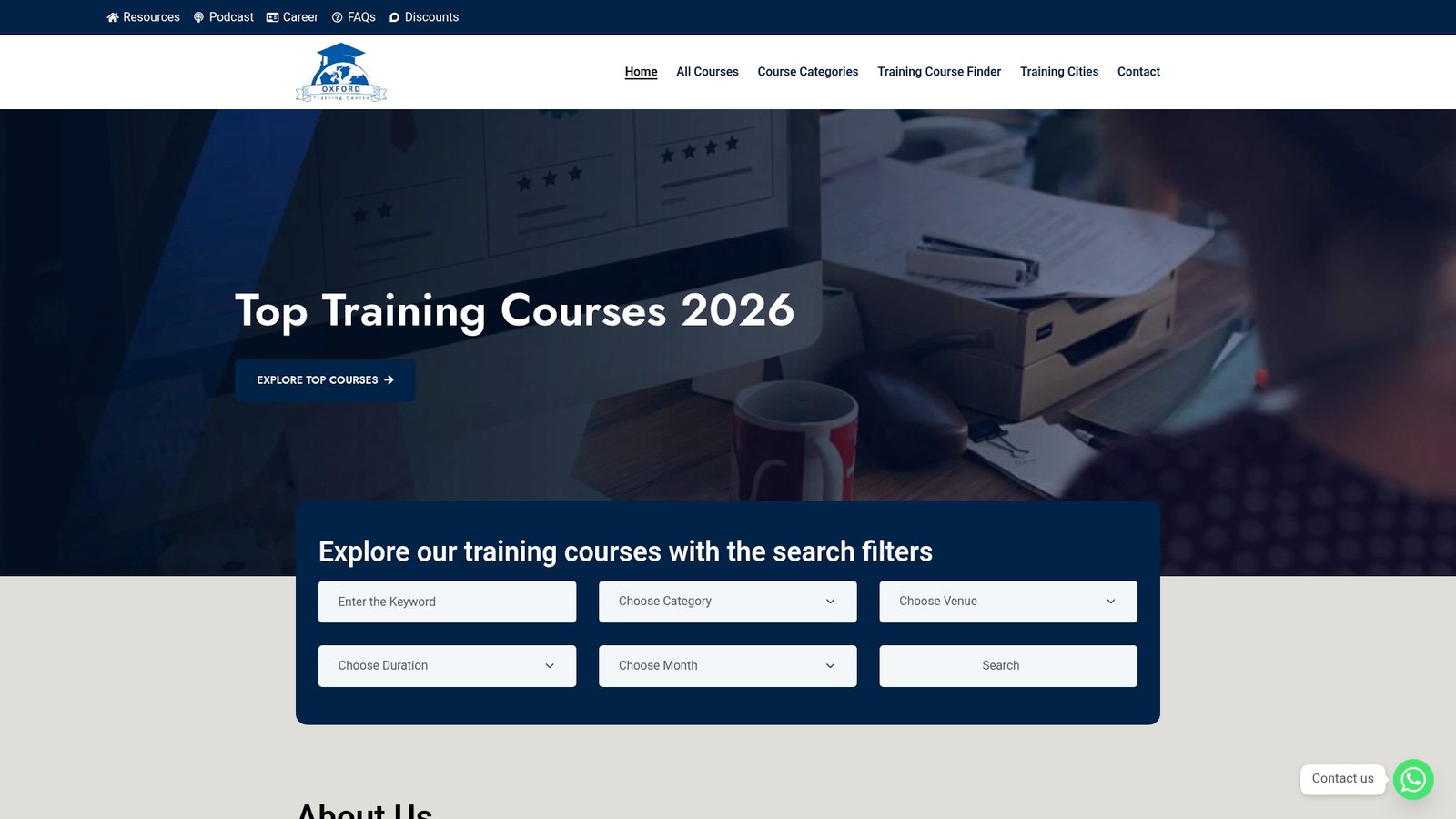
Rather than committing to a full rollout on faith, you can request a scoping call to map your team’s skills gaps, or propose a structured pilot cohort before scaling to the wider organisation. If you’d rather see the range first, a sample programme outline is available on request. Start by visiting Oxford Training Centre to enquire about a scoping call or pilot programme suited to your team’s roles and timeline.
Sources
- How to select a training vendor: a step-by-step guide — Training Industry
- How to evaluate IT training vendors — Boost eLearning
- L&D’s complete guide to choosing the right training vendors — Hone
FAQ
What Counts as Corporate IT Training?
It means accredited, customisable IT and computer science courses built for workplace roles, delivered on-site, online or blended, as distinct from university degrees or free consumer coding classes.
How Long Should a Training Pilot Run?
A structured pilot typically runs 60 to 90 days with five to eight participants, long enough to measure completion rates, score improvement and manager-observed application before scaling.
Which Course Formats Work Best for Distributed Teams?
Blended delivery, combining live-online or on-site sessions with self-paced modules, tends to suit distributed teams best, provided the platform includes live labs and LMS integration.
How Do I Know If a Training Vendor Is Worth the Cost?
Score vendors on domain expertise, lab quality, instructor industry experience and content update cadence, then validate the claims with a pilot rather than a demo alone. Some training providers structure their accredited programmes around exactly this sequence, from needs analysis through to measured delivery.
Do These Courses Prepare Staff for Certification Exams?
Yes, provided the vendor maps content to current exam blueprints and refreshes material regularly, since outdated course content is one of the most common causes of exam failure.