
Choose accredited, customisable corporate training built on a proper training needs analysis, run a pilot against pre-agreed KPIs, then scale what works. A relevant provider for this route is one capable of running discovery and pilot phases. The next move is simple: agree a one to two week discovery sprint with named deliverables before anyone signs off on a course catalogue.
TL;DR:
- Customised, accreditation-based training with a clear needs analysis and KPIs often achieves up to 50% higher transfer and effectiveness than generic courses.
- Standardise content for regulatory or large-scale uniform compliance, but tailor modules for roles with different risk profiles or operational needs.
- Require vendors to provide a training needs analysis, facilitator CVs, actual sample sessions, and a pilot plan with measurable KPIs before signing any contract.
- Delivery should be chosen based on scale and geography, with blended formats offering the most flexibility for diverse or global teams.
- Post-programme support, including manager enablement tools, refresher content, and a defined follow-up period of 30 to 90 days, is essential for lasting impact.
Table of Contents
- What “shipping, maritime and ports training courses” means for corporate buyers
- Why customised, accredited programmes usually beat off-the-shelf courses
- Procurement checklist: what to demand in an RFI or RFP
- Choosing on-site, online or blended delivery
- Cost drivers, a pilot budget model, and contractual red flags
- Measuring impact: the KPI set that HR and finance will actually trust
- What a broad accredited course catalogue should actually cover
- Segmenting training by role: building pathways that fit different teams
- How long do these programmes run and how flexible is scheduling?
- What happens after the course ends?
- Do case studies actually prove training works?
- What does pricing actually look like once you add it all up?
- Author perspective: the procurement mistakes that keep repeating
- How the Oxford Center runs your discovery sprint and pilot
- Sources
- FAQ
What “shipping, maritime and ports training courses” means for corporate buyers
When HR teams search for shipping, maritime and ports training courses, they usually mean something more specific than seafaring qualifications: accredited, customisable programmes in project management, compliance, safety and leadership that can be adapted for logistics-heavy, maritime-adjacent, or operationally complex organisations. This is corporate training with global accreditation, not deck officer certification.
Typical learning objectives for this buyer group include:
- Project management fundamentals aligned to recognised frameworks such as those from PMI
- Regulatory and safety compliance training tailored to sector-specific risk
- Leadership and supervisory development for operational managers
- Logistics-adjacent skills: scheduling, resource planning, vendor coordination
Decision-makers usually include the L&D director, the HR business partner sponsoring the budget, and an operations lead who owns the outcome the training is meant to fix.
Why customised, accredited programmes usually beat off-the-shelf courses
Generic modules are cheap and fast, but they rarely stick. Custom eLearning aligns training to how an organisation actually works, which tends to produce better application on the job than a course built for nobody in particular. Personalised design can lift transfer and effectiveness by as much as 50% compared with non-tailored training, a gap that matters when only a fifth of most training investment survives past the classroom.
Standardisation still wins in specific cases: compliance content that must be identical across every site, or large cohorts where consistency matters more than nuance. The practical middle ground is a modular core-plus-elective design, where a fixed foundation carries the compliance load and elective modules handle role-specific variation.
Use this quick filter before you brief any vendor:
- Standardise if the content is regulatory, high-volume, or legally sensitive
- Customise if roles, tools, or risk profiles vary significantly across sites
- Hybrid if you need consistency on fundamentals but relevance at the role level
Pro Tip: Ask your shortlisted vendor to show you a core-plus-elective structure from a past client before you commit to a fully bespoke build. It reveals how disciplined their customisation process actually is.
Procurement checklist: what to demand in an RFI or RFP
The most common procurement mistake is judging vendors on their course catalogue rather than their diagnostic process. Buyers should start with a training needs analysis and pre-agreed KPIs, not a slide deck of module titles. Build your RFP around four requirements:
- A TNA deliverable. Ask for discovery sprint outputs, a competency map, and a role-task learning path that shows exactly which tasks the training is meant to improve.
- Trainer dossiers and recorded samples. Insist on facilitator CVs, recent recorded sessions, and at least two outcome-linked references where the named trainer actually led the delivery, not a substitute.
- A pilot plan with defined KPIs. Require a measurement window, typically 30 to 90 days, with agreed success thresholds and a documented commitment to iterate if results fall short.
- Integration and post-programme measurement. Specify how results feed into your LMS or HRIS, who enables managers to reinforce the training, and whether a named coach role exists after the course ends.
Beyond these four, worth adding to any RFP:
- Evidence of a repeatable customisation workflow, not just a one-off bespoke deck, supported by sample prototypes and a versioning plan
- A contingency plan if the named facilitator becomes unavailable, ideally a co-delivery model pairing subject experts with professional facilitators
- Clarity on what happens to content ownership and updates after the contract ends
A vendor who resists any of these four items is telling you something. Move on.
Choosing on-site, online or blended delivery
Delivery decisions come down to scale, geography and how fast you need results. A realistic timeline runs discovery for one to two weeks, prototyping for two to three weeks, a pilot for four to twelve weeks, then a scale phase that depends entirely on cohort size.
Each delivery format carries trade-offs:
- On-site works best for hands-on safety or leadership content where group dynamics matter, but it is the hardest to scale across multiple sites.
- Synchronous online keeps the interaction of a classroom while cutting travel costs, though time zones can be a genuine constraint for global teams.
- Self-paced online scales cheaply and lets employees learn at their own pace, but completion rates drop without manager reinforcement.
- Blended combines a self-paced core with live sessions for application and coaching, and it is usually the most durable choice for mid-size to large cohorts.
Scaling a pilot into a full rollout typically follows one of three patterns: modular roll-out by business unit, train-the-trainer to build internal capacity, or co-delivery where the vendor and internal facilitators share the load during the transition. The role of digital tools in logistics training is worth reviewing if your organisation already runs on integrated planning systems, since your LMS choice will shape how easily any of these three patterns actually work in practice.
Cost drivers, a pilot budget model, and contractual red flags
Price varies enormously because the inputs vary enormously. The main cost drivers are custom instructional design time, subject-matter-expert hours, platform or LMS fees, facilitator day rates, and assessment or certification costs. A fully bespoke programme with dedicated SME involvement will always cost more than adapting an existing core-plus-elective library.
A simple pilot budget model: allocate roughly a third of spend to discovery and design, a third to delivery across the measurement window, and the final third held back for iteration once pilot data comes in. A 30 to 90 day measurement window is usually enough to see whether behaviour is shifting.
Watch for these red flags in any contract:
- Vague language about “senior facilitators” with no named individual attached
- No pre-agreed pilot KPIs, only a promise to “measure satisfaction”
- No versioning clause covering who updates content once regulations or processes change
- Pricing that bundles assessment and certification fees into a single opaque line item
Pro Tip: Never release the final third of a pilot budget until the vendor has shown you actual measurement data against the KPIs you agreed at the outset, not attendance figures.
Measuring impact: the KPI set that HR and finance will actually trust
Attendance numbers tell you nothing about impact. The KPI set that matters combines baseline performance, application rate, manager-observed behaviour change, a link to a business metric, and cost-per-impact once the pilot closes.
Ownership should sit with L&D for design and reporting, HRIS for data capture, and line managers for observing whether behaviour actually changes on the job. Report at fixed intervals rather than waiting for a single end-of-year review.
- At 30 days, expect early application signals: are people using the new process at all?
- At 90 days, expect measurable behaviour change reported by managers, not just self-reported confidence.
- At 180 days, expect a link to a business metric, whether that is error rates, incident reports, or throughput.
Only around 10 to 20% of standard training content survives long enough to be applied on the job over time, which is exactly why personalised approaches that map to real tasks produce a measurably different outcome than generic modules.
What a broad accredited course catalogue should actually cover
A corporate provider serving operationally complex sectors needs breadth across several practical areas rather than a single flagship course. Project management sits at the centre for most buyers, since scheduling, resourcing and cross-team coordination are common pain points across logistics-heavy operations. Compliance and safety training forms a second pillar, covering risk assessment, incident reporting, and regulatory awareness relevant to the buyer’s sector.
Leadership and people management modules round out the catalogue for supervisors and operational managers who need to translate technical competence into team performance. Beyond these three pillars, a well-built catalogue typically includes:
- Health, safety and environmental (HSE) management aligned to recognised standards
- Civil engineering and technical operations training for organisations with physical infrastructure
- IT and digital skills modules that support the systems most operations now depend on
- Quality management and process improvement courses
The value of a broad catalogue is not variety for its own sake. It is the ability to build a single learning pathway that mixes a compliance module with a leadership module and a technical module, all mapped against the same competency framework, so employees are not stitching together unrelated courses from three different providers. Ask any vendor to show how their catalogue maps against a role, not just a subject area. If they can only describe individual courses in isolation, that is a sign their design process starts with content rather than with your organisation’s actual competency gaps.
Segmenting training by role: building pathways that fit different teams
A single course rarely fits every employee group, and treating training as one-size-fits-all is one of the more expensive mistakes HR buyers make. Segmentation should start with the outcome each group needs, not with which department requested the budget.
Frontline operational staff typically need short, practical modules focused on safety procedures and day-to-day process compliance, delivered in formats that fit shift patterns rather than a full working day away from the floor. Supervisors and team leads need a different pathway entirely: leadership fundamentals, performance conversations, and enough operational knowledge to coach the teams they manage. Senior managers and directors usually need strategic and regulatory content, often benchmarked against recognised frameworks such as PMI’s project management certifications, where project leadership forms part of their role.
A practical segmentation model looks like this:
- Operational roles: short, task-specific modules with high repetition and low time-away-from-work
- Supervisory roles: blended leadership and technical pathways with coaching components
- Management and regulatory roles: strategic, compliance-heavy content, often benchmarked against external standards
The mistake to avoid is building one “comprehensive” course and hoping it serves all three groups. It rarely does, because the tasks, time constraints and prior knowledge differ too much between a frontline employee and a director. Ask any vendor how they segment learning paths by role before you ask what topics they cover. The answer to the first question determines whether the second one even matters.
How long do these programmes run and how flexible is scheduling?
Duration depends entirely on scope, but most corporate programmes fall into a few recognisable bands. Short compliance or safety refreshers typically run half a day to two days. Leadership and project management courses often run three to five days when delivered intensively, or spread across several weeks when delivered as a blended pathway with live sessions and self-paced work between them.
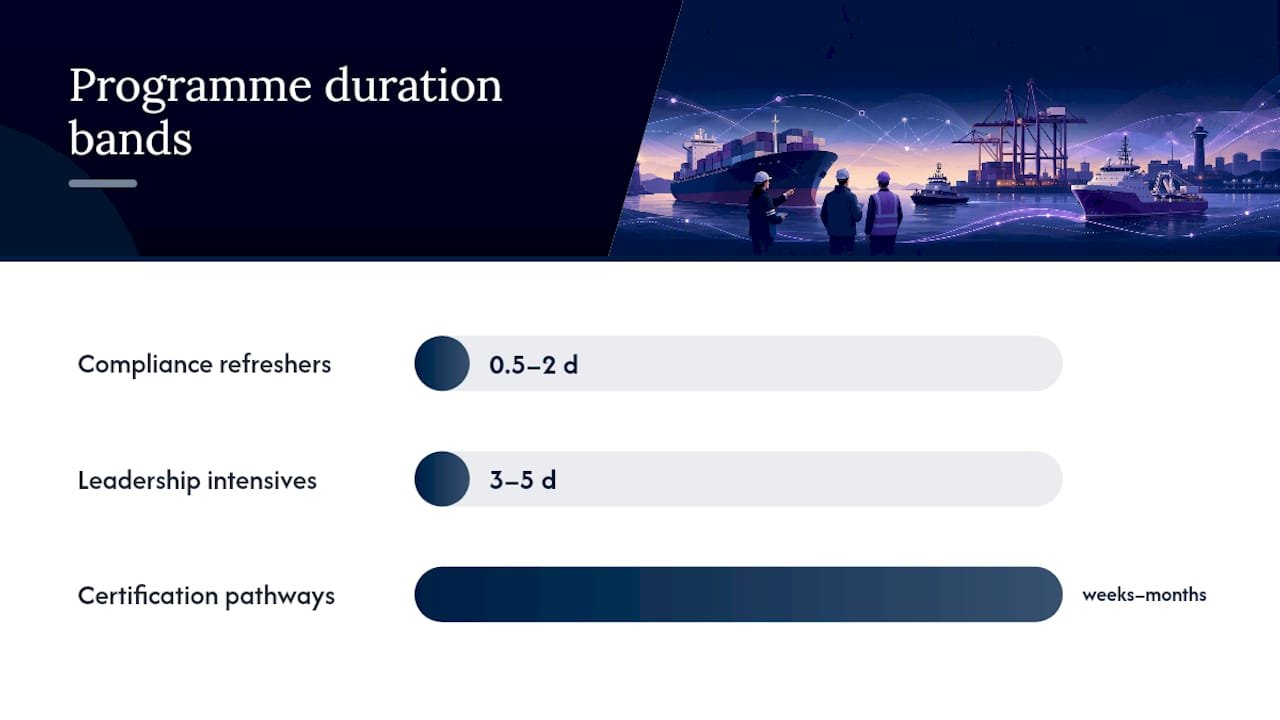
Full certification pathways, particularly those aligned to recognised standards, can run several weeks to a few months when they include practical assessment or a capstone project. This is where scheduling flexibility becomes the real differentiator between providers, not the course content itself.
Flexibility usually shows up in three ways:
- Cohort scheduling: fixed intake dates for group cohorts versus rolling enrolment for individuals
- Format flexibility: self-paced online modules that let shift workers complete sections between rotations
- Modular pacing: breaking a longer certification into standalone modules that can be spread across a quarter rather than delivered in one intensive block
For organisations with shift patterns, seasonal peaks, or global teams across time zones, rigid scheduling is often the real barrier to completion, not course content. A vendor offering only fixed-date, fixed-length cohorts will struggle to fit around a 24-hour operation. Ask specifically how a provider handles a learner who misses a live session, since the answer reveals whether their design genuinely accounts for operational reality or just assumes everyone sits at a desk from nine to five.
What happens after the course ends?
Training that stops the moment the course finishes rarely produces lasting change, which is why post-programme support deserves as much scrutiny as the course design itself. The strongest programmes build in a defined period of follow-up, whether that is manager coaching prompts, refresher content, or access to a named contact for questions that come up once learners are back on the job.
Look for three things when evaluating post-training support:
- Manager enablement materials: short guides or prompts that help supervisors reinforce what their team just learned
- Access to refreshed content: especially important where regulations or processes change, since static content ages quickly
- A defined support window: a specific period, commonly 30 to 90 days, during which learners or managers can raise questions with the training provider
Continuous learning opportunities matter just as much for retention as the initial course. Employees who complete a single course and then hear nothing for a year tend to lose the skill faster than those offered a follow-up module or an advanced pathway. A well-structured provider will offer a route from foundational training into more advanced or specialised modules, ideally mapped against the same competency framework used in the original TNA, so progression feels connected rather than like starting from zero again.
Do case studies actually prove training works?
Case studies are useful, but only when they show a measurement window and a named metric, not just a satisfied quote. A case study that reports “high engagement” without a baseline comparison tells you almost nothing about whether behaviour actually changed.
The strongest evidence links training to a specific business outcome: fewer incidents, faster onboarding, improved project delivery timelines, or a measurable shift in a manager-observed competency. Ask any vendor presenting a case study three questions: what was the baseline before training, what changed within the agreed measurement window, and who verified the result. If a provider cannot answer all three, treat the case study as marketing rather than evidence.
This is also where the pilot structure described earlier in this article pays off directly. A pilot with pre-agreed KPIs and a defined measurement window produces exactly the kind of evidence a genuine case study needs, rather than relying on a vendor’s own retrospective account of a project delivered months or years earlier. Buyers who insist on this structure end up with their own internal case study, built on their own data, which is a far stronger basis for scaling a programme than borrowing someone else’s success story.
What does pricing actually look like once you add it all up?
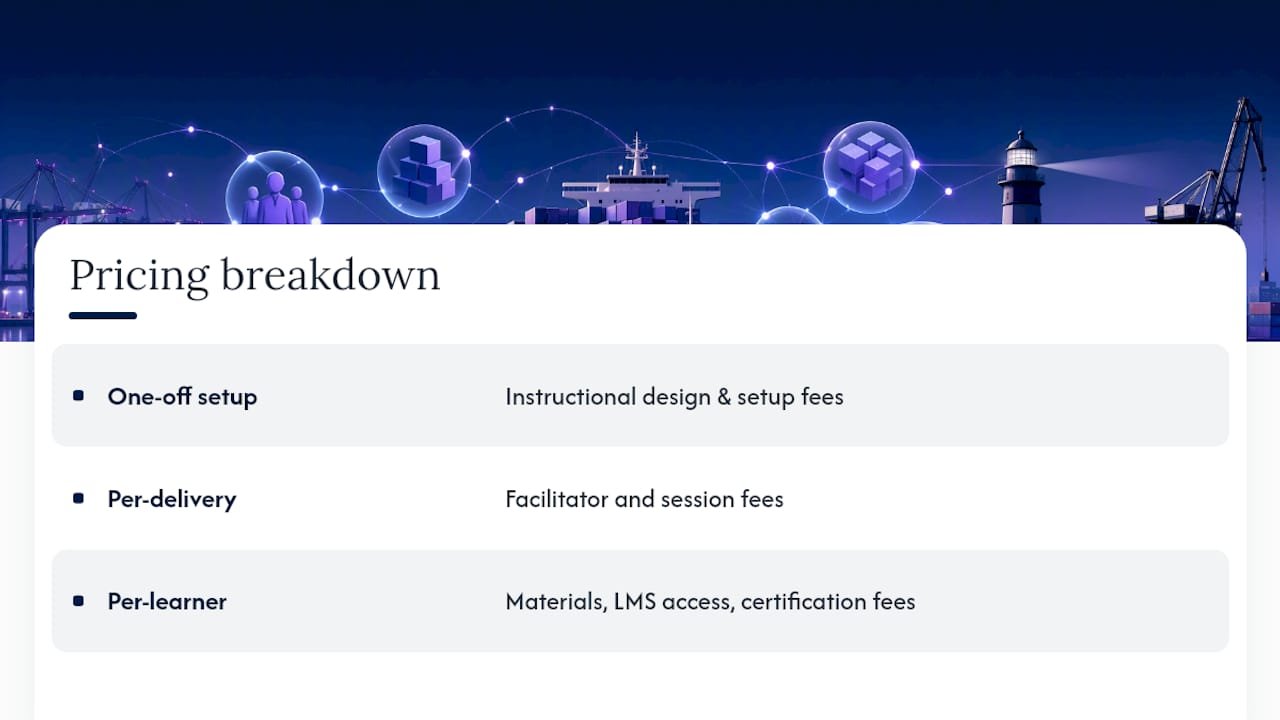
Pricing for accredited corporate training rarely sits at a single flat rate, because the inputs vary so much between a short compliance refresher and a fully bespoke leadership pathway. The total cost estimate should always include several components beyond the headline day rate: instructional design time for any customisation, facilitator day rates, platform or LMS access fees if delivery runs through a dedicated system, and assessment or certification fees where the course leads to a recognised credential.
Materials are the line item most commonly left out of an initial quote. Workbooks, access to recorded sessions after the live course, and any assessment retake fees can add meaningfully to the total if they are not clarified upfront. Ask for a single itemised quote rather than a headline per-person price, since bundled pricing tends to hide exactly these extras.
A useful way to sense-check any quote is to separate it into three categories: one-off design and setup costs that apply regardless of cohort size, per-delivery costs that scale with the number of sessions or cohorts run, and per-learner costs such as materials and certification fees. This structure also makes it much easier to model what scaling a pilot into a full rollout will actually cost, since one-off design costs do not repeat but per-learner costs multiply directly with headcount. Any vendor unwilling to break a quote down this way is worth questioning before you sign.
Author perspective: the procurement mistakes that keep repeating
The pattern is depressingly consistent: buyers ask to see a course catalogue before they have defined what success looks like. That is backwards. A catalogue tells you what a vendor sells, not whether it will fix the actual gap in your organisation, and a content-first procurement process almost guarantees you will judge providers on the wrong criteria.
The fix is not complicated, but it is uncomfortable for anyone under pressure to move fast: insist on trainer CVs and recorded sample sessions before signing anything, and refuse to accept a vague promise of “senior facilitators” without a named person attached. Request a co-delivery or contingency plan too, since trainer substitution is one of the most common ways pilots quietly underdeliver.
Author background, named case studies and client testimonials to be added as this programme develops.
— Sam
How the Oxford Center runs your discovery sprint and pilot
There are providers offering a practical alternative to piecing together generic, one-size-fits-all courses from multiple sources: a single partner that customises design, runs pilots, and aligns to client KPIs. Such programmes include project management, compliance, safety, leadership and more, delivered on-site, online, or blended based on team needs.
A practical next step is to agree a time-boxed discovery sprint with your chosen provider, define the competency map and role-task learning path together, then run a pilot against KPIs set before building any modules. That sequence helps protect budget and provides evidence before scaling. Visit the Oxford Training Centre to start scoping your discovery sprint and get a pilot proposal built around your own performance metrics.
Sources
The guidance in this article draws on established procurement and instructional design practice. For deeper reading on vendor selection discipline, see TrainingIndustry’s step-by-step vendor guide and SIGMA’s practical guide for HR and talent leaders. On customisation and application rates, eLearning Industry’s analysis of custom eLearning benefits is worth a read, alongside PMI’s certification framework for role-based benchmarking.
- How to select a training vendor: a step-by-step guide
- The benefits of custom eLearning development for corporate training
- How to choose a training provider: a practical guide for HR and talent leaders
- PMI — certifications
FAQ
What is the first step in buying corporate maritime-adjacent training?
Run a training needs analysis before reviewing any course catalogue, then define the KPIs a pilot will be measured against.
How long should a training pilot run before scaling?
Most pilots need a measurement window of 30 to 90 days to show whether behaviour is genuinely changing on the job.
Should we customise training or use a standard course?
Customise when roles or risk profiles vary significantly; standardise for compliance content; use a modular core-plus-elective hybrid when you need both.
What should we ask vendors for before signing a contract?
Request trainer CVs, recorded sample sessions, at least two outcome-linked references, and a pilot plan with pre-agreed KPIs, as offered by providers such as the Oxford Center.
What KPIs actually prove training worked?
Track baseline performance, application rate, manager-observed behaviour change, and a link to a specific business metric at 30, 90 and 180 days.