
Key Points
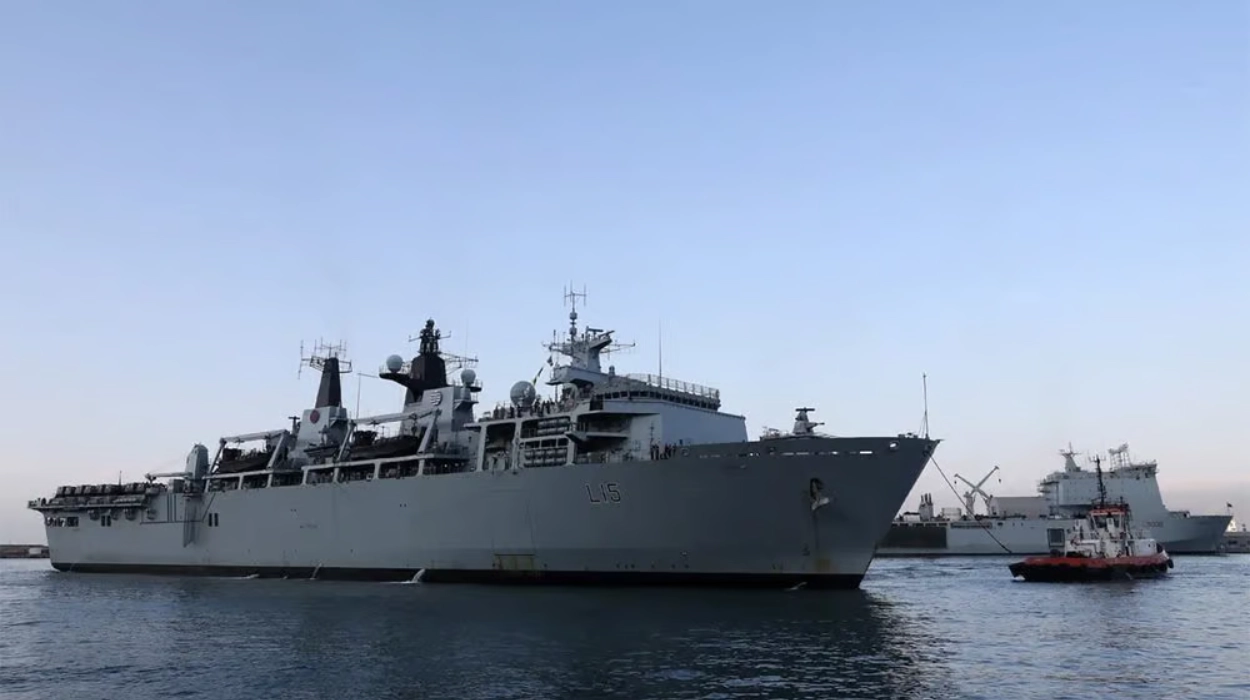
- The UK Ministry of Defence has confirmed the sale of HMS Bulwark (L15) to the Brazilian Navy, ending more than two decades of Royal Navy service.
- The 176-metre Albion-class amphibious assault ship was commissioned in 2005 and served as the Royal Navy’s Fleet Flagship from 2011 to 2015.
- According to The Maritime Executive, HMS Bulwark supported the evacuation of civilians from Lebanon during the 2006 crisis, maritime security during the London 2012 Olympics, and counter-piracy operations in the Horn of Africa.
- The UK government has invested heavily in the vessel’s regeneration and midlife upgrade, with parliamentary records putting expenditure on the 2022–24 refit at £72.1 million.
- The exact agreed sale price has not been publicly confirmed by the UK Ministry of Defence, although media reports have put the figure at about £20 million, or approximately $26 million.
- Brazil is preparing the former HMS Bulwark to enter service as NDM Oiapoque (G350).
- Brazilian personnel have already been involved in receiving, preparing and training for the ship at Devonport, with Brazilian defence reporting saying the receiving group reached 263 military personnel.
- The transfer is part of a broader UK decision to replace the Albion-class capability with a new amphibious fleet developed with the Netherlands.
- The UK and Netherlands agreed a £2.4 billion maritime partnership in July 2026 covering eight next-generation amphibious transport ships.
- The future vessels will be around 160 metres long, displace 15,000 tonnes and be designed to transport troops, vehicles, equipment and drones.
- The UK says the new programme will support hundreds of highly skilled British jobs and strengthen interoperability with the Netherlands and NATO.
- HMS Bulwark’s sister ship, HMS Albion, remains at HMNB Devonport awaiting disposal.
- The sale continues a pattern of British naval vessels entering Brazilian service, following Brazil’s acquisition of the former HMS Ocean, now NAM Atlântico.
Inverted-pyramid structure: The most significant development is the confirmed transfer of HMS Bulwark to Brazil, followed by the financial and operational background, the ship’s Royal Navy record, the preparation for Brazilian service and the UK’s wider shift towards a new amphibious fleet.
Why has the UK confirmed the sale of HMS Bulwark to Brazil?
The United Kingdom has formally confirmed that HMS Bulwark (L15) will be sold to the Brazilian Navy, bringing the Royal Navy career of one of its best-known amphibious assault ships to an end.
The UK Ministry of Defence announced the decision on 28 August 2026, saying the transfer would conclude more than two decades of Royal Navy service as Britain changes its approach to amphibious operations.
The confirmation followed months of speculation surrounding the future of the Albion-class vessels. The Maritime Executive, in its report published on 4 September 2026, said the Ministry of Defence had confirmed the “long-rumored” transfer of HMS Bulwark to Brazil. The publication reported that Bulwark had been inactive for years while undergoing a life-extension and modernisation programme.
The government’s announcement places the sale within a much broader restructuring of British naval capability. Rather than returning Bulwark to Royal Navy operational service after its regeneration, the UK is moving towards a new amphibious transport capability being developed jointly with the Netherlands.
What is the history of HMS Bulwark in Royal Navy service?
HMS Bulwark was commissioned in 2005 as one of two Albion-class amphibious assault ships operated by the Royal Navy. Her sister vessel is HMS Albion.
According to The Maritime Executive, Bulwark was active from 2005 to 2016 and played a significant role in British military and humanitarian operations. The publication highlighted her involvement in the evacuation of civilians from Beirut during the 2006 Lebanon crisis.
The UK Ministry of Defence also records Bulwark’s involvement in civilian evacuation operations from Lebanon in 2006 and maritime security duties during the Sailing Regatta at the London 2012 Olympic Games.
The ship also served as the Royal Navy’s Fleet Flagship between 2011 and 2015. During her career, her core functions included amphibious deployments, humanitarian assistance and multinational exercises involving Britain’s allies and partners.
The Maritime Executive additionally reported that Bulwark participated in counter-piracy operations in the Horn of Africa, alongside other naval exercises and international activities.
How much did Britain spend regenerating HMS Bulwark?
The financial background to the sale has attracted attention because Britain invested substantially in HMS Bulwark before deciding to dispose of the vessel.
The Maritime Executive reported that the British government had spent approximately $100 million on Bulwark’s midlife upgrade project, which was nearing completion. According to the publication, the work included modernisation of command-and-control systems, communications upgrades and a comprehensive overhaul of propulsion and power-generation systems. The intended objective was to extend the ship’s operational life by another two decades.
UK parliamentary records provide a more specific figure for expenditure during the later refit period. In a written answer on 21 November 2025, Defence Minister Luke Pollard said £72.1 million had been spent refitting HMS Bulwark between 2022 and 2024. He also said neither Bulwark nor Albion was due to return to sea before their previously planned out-of-service dates in 2033 and 2034.
The figures have become an issue because the ships were retired before their modernisation programmes could translate into renewed Royal Navy service.
In January 2025, Maria Eagle, then Minister for Defence Procurement and Industry, told Parliament that HMS Albion and HMS Bulwark had been laid up awaiting disposal and that the vessels required costly and time-consuming refits. She said their sale would save approximately £9 million a year in maintenance costs, in addition to generating proceeds that could be invested in modernisation.
What is the sale price of HMS Bulwark?
The British government has not publicly disclosed the final agreed sales figure in its formal announcement.
The Maritime Executive reported that the government had not revealed the price but that reports indicated Bulwark was sold for approximately $26 million.
Other defence reporting has placed the reported figure at around £20 million. Forces News, in a report by Joe Hearn published on 18 June 2026, said HMS Bulwark had been announced for sale to the Brazilian Navy for a reported £20 million.
However, the distinction between reported figures and an officially disclosed sale price remains important.
On 1 September 2026, Conservative MP Ben Obese-Jecty asked the Secretary of State for Defence about both the regeneration costs and the agreed sales figure for HMS Bulwark. The parliamentary question was scheduled to be answered by the Ministry of Defence on 3 September.
Earlier, on 4 June 2026, Luke Pollard, Defence Readiness and Industry Minister, said regeneration costs had not yet been confirmed and would be announced in due course. He added that the cost of regeneration would be offset by the agreed sales figure, which was expected to provide a net return for the Ministry of Defence.
This means the widely reported £20 million figure should be treated as a reported sale price rather than an officially confirmed figure from the Ministry of Defence, unless and until the government publishes the final amount.
When did Britain and Brazil begin discussing the sale?
The sale followed a lengthy process rather than a single transaction announced without prior negotiations.
In January 2025, Maria Eagle confirmed that the Royal Navy was exploring government-to-government sales of both HMS Bulwark and HMS Albion. At that point, several potential customers had expressed interest, but no final decisions had been taken.
On 10 February 2025, Eagle told the House of Commons that neither ship was expected to return to sea before its previously planned out-of-service date. She confirmed that several potential customers were interested but said there had been no final decision.
On 30 April 2025, Eagle told Conservative MP Ben Obese-Jecty that she had witnessed the signing of a Statement of Intent between Brazil and the UK Ministry of Defence during a visit to Brazil. The statement concerned cooperation and assistance connected with the potential acquisition of HMS Albion and HMS Bulwark. Eagle described the development as significant for bilateral defence cooperation but said further information could not be released because of commercial sensitivities.
By 2026, the process had progressed from discussions and technical assessments towards the physical preparation of Bulwark for Brazilian service.
What will HMS Bulwark be called in the Brazilian Navy?
The former British warship is being prepared for Brazilian service under the name NDM Oiapoque, with the pennant G350.
Brazilian defence publication Poder Naval, in a report by its Forças de Defesa editorial team published on 3 August 2026, reported that the future NDM Oiapoque had already displayed the Brazilian G350 pennant while berthed at Devonport in Plymouth. The report said the vessel was undergoing revitalisation, certification and systems preparation before its final transfer.
A separate Poder Naval report published on 25 July said the former HMS Bulwark was displaying the Brazilian G350 marking and undergoing final preparation at Devonport. It reported that the ship was expected to transfer in a “Ready to Sail” condition, with Brazil’s 2025 management report using the end of 2026 as a reference for delivery.
How is Brazil preparing the former HMS Bulwark for service?
Brazil has already begun preparing personnel for the ship’s operation.
According to Marcelo Barros of Defesa em Foco, the final contingent of Brazil’s receiving group arrived aboard HMS Bulwark on 29 May 2026. The arrival of the so-called Charlie Group completed the receiving organisation, bringing the total number of Brazilian military personnel involved to 263.
The personnel are responsible for receiving, preparing and bringing the vessel towards operational readiness under the Brazilian flag. Their involvement is also intended to support knowledge transfer and training for the future crew.
Marcelo Barros, reporting with information and images from the Brazilian Navy, said the personnel would act as multipliers of the experience gained during the preparation phase, helping accelerate the ship’s operational preparation.
Brazilian reporting has also described work covering the bridge, combat operations centre, flight deck, floodable dock, amphibious-operation spaces and accommodation areas. The objective is to prepare British equipment and systems for operation under Brazilian procedures.
Angelo Daniel Nicolaci Mota, writing for Zona Militar on 24 June 2026, reported that sources consulted during a Brazilian defence event said the work being carried out in Britain did not represent additional costs for the Brazilian Navy.
Where could NDM Oiapoque operate after entering Brazilian service?
The Maritime Executive reported that the ship is expected to be particularly useful in Brazil’s Blue Amazon region, where it could support a broad range of military and humanitarian-assistance activities serving civilian communities.
Its amphibious configuration gives Brazil a platform capable of supporting personnel, equipment and vehicles, while its large internal spaces and dock facilities provide flexibility for missions beyond conventional combat operations.
Brazilian defence reporting has similarly identified amphibious operations, logistical support and humanitarian assistance among the ship’s expected functions.
Why is Britain replacing the Albion-class capability?
The sale of HMS Bulwark is linked directly to Britain’s changing approach to amphibious warfare.
The UK government said the transfer follows a £2.4 billion maritime partnership with the Netherlands, confirmed in July 2026. The agreement will provide a fleet of eight next-generation amphibious transport ships, with four operated by each country.
The future vessels are planned to be approximately 160 metres long and displace around 15,000 tonnes. They are intended to transport troops, vehicles and equipment, including drones, to locations where they are required.
The new fleet is also intended to incorporate modern uncrewed and autonomous technologies. The Ministry of Defence said its flight decks are being designed to accommodate current and future long-range drones and autonomous systems.
The programme forms part of Britain’s proposed transition towards what the government describes as a hybrid Navy, backed by £1.5 billion in the Defence Investment Plan.
What will happen to HMS Albion?
HMS Bulwark’s sister ship, HMS Albion (L14), remains at HMNB Devonport awaiting disposal.
The two ships had previously been mothballed rather than routinely operated. Parliamentary records show that the UK government had been examining options for selling both vessels, although the final outcome for Albion remains separate from the confirmed Bulwark transaction.
The Maritime Executive reported that Albion is likely to face a similar fate, although the publication described its disposal as pending rather than confirmed as part of the same completed transaction.
Does the sale continue a wider UK-Brazil naval relationship?
The Bulwark transfer is not the first major Royal Navy vessel to move into Brazilian service.
The Maritime Executive noted that Brazil previously acquired the former British aircraft carrier HMS Ocean, which became NAM Atlântico (A140). Brazil acquired the vessel in 2018 for approximately $84 million, and it subsequently became the flagship and largest warship of the Brazilian Navy.
The Bulwark transaction therefore adds another former British major warship to Brazil’s fleet while maintaining a defence relationship between London and Brasília.
For Britain, meanwhile, the sale represents the latest stage of a transition away from the existing Albion-class amphibious capability towards a new UK-Netherlands force designed around interoperability, autonomous technology and modern amphibious transport.
What does the HMS Bulwark sale mean for UK defence and maritime capability?
The sale illustrates the tension between maintaining existing military platforms and redirecting resources towards newer capabilities.
The UK government presents the decision as part of a modernisation programme. Lord Coaker, Minister of State for Defence, said HMS Bulwark had served Britain and its allies with distinction for more than two decades and welcomed the prospect of the vessel continuing its career with Brazil, which he described as a longstanding defence partner.
Coaker also linked the new UK-Netherlands amphibious programme to the modernisation of the Armed Forces and British shipbuilding, saying the partnership would provide personnel with modern interoperable capabilities while supporting British skills and shipyards.
Critics, however, have questioned the financial logic of investing heavily in Bulwark’s regeneration before the ship was sold without returning to sustained Royal Navy service. Those concerns have appeared alongside wider questions about the timing of replacement amphibious capability.
The government’s position is that the old ships were effectively mothballed and that disposal will reduce maintenance costs while freeing resources for modernisation. In a January 2025 parliamentary response, Maria Eagle said the sale of the vessels would save £9 million annually in maintenance costs, in addition to any proceeds from disposal.
The emerging picture is therefore one of transition rather than a straightforward abandonment of amphibious warfare. Britain is selling HMS Bulwark to Brazil while simultaneously committing to a new generation of amphibious transport vessels with the Netherlands.
For professionals tracking the implications of major naval acquisitions, ship transfers, infrastructure programmes and defence supply chains, developments such as the Bulwark transaction intersect with Shipping, Maritime and Ports, Logistics and Supply Chain, Project Management, Legal, Contracts and Procurement, and Safety and Security training, particularly where international defence cooperation, vessel lifecycle management, maritime operations and complex procurement programmes are involved.