

The Kirkpatrick model evaluates training at four levels: Reaction, Learning, Behaviour and Results. Each level asks a harder question than the one before. Did people value the training? Did they learn something? Are they doing their jobs differently? Did the organisation benefit? This guide explains each level, gives measures you can use, and shows how to carry an evaluation from the training room into the workplace.
TL;DR
- The model was developed by Donald Kirkpatrick in the 1950s and is still one of the most widely recognised training evaluation frameworks.
- The four levels are Reaction, Learning, Behaviour and Results. Work through them in order, but plan all four before the course starts.
- Levels 1 and 2 are quick to measure. Levels 3 and 4 need manager involvement and follow-up weeks or months later.
- Results are shaped by many factors besides training, so aim for credible evidence of contribution rather than proof of sole cause.
- Agree the business outcome with stakeholders first, then design the training and the measures backwards from it.
Table of Contents
- What the Kirkpatrick model is
- The four Kirkpatrick levels of evaluation
- How to use the model to evaluate a training programme
- Kirkpatrick model examples
- Connecting evaluation to behaviour and business results
- Strengths and limits of the model, and how to work with them
- Our perspective
- Plan training you can evaluate
- FAQ
- Sources
What the Kirkpatrick model is
The Kirkpatrick model is a framework for judging whether a training programme has worked. Donald Kirkpatrick developed it in the 1950s, and it remains widely recognised in education, HR and learning and development (L&D) today. Its appeal is simplicity. Instead of asking only “did people enjoy the course?”, it gives you four questions that move from the classroom to the business.
The levels build on each other. Evidence at a lower level helps explain what you find higher up. If Level 3 shows no change in behaviour, the lower levels help you see why: perhaps people did not understand the material, or perhaps they understood it but had no chance to use it.
The four Kirkpatrick levels of evaluation
| Level | Name | Question it answers | Typical measures | When to measure |
|---|---|---|---|---|
| 1 | Reaction | Did participants find the training favourable, engaging and relevant? | Feedback forms, surveys, in-class responses | During and straight after |
| 2 | Learning | Did they gain the intended knowledge, skills, confidence and commitment? | Knowledge tests, role-plays, practical assessments | End of training, often with a pre-test |
| 3 | Behaviour | Are they applying it at work? | Supervisor observation, checklists, work samples | Weeks to months after |
| 4 | Results | Did the organisation benefit? | Cost, quality, safety, productivity, retention data | Medium to long term |
Level 1: Reaction
Level 1 measures how far participants find the training favourable, engaging and relevant to their jobs. The usual tools are feedback questionnaires or surveys, and individual responses in class.
The phrase that matters most is “relevant to their jobs”. A session can be enjoyable and still irrelevant, so ask about relevance as directly as you ask about enjoyment. Useful questions include:
- How likely are you to use what you learned in the next month?
- Which part of the session will be most useful in your role?
- What got in the way of your learning?
- What would you change about the format or pace?
If you run training through a digital platform, collecting this feedback is easier when registration, delivery and surveys sit in one place. Event and learning management systems can help you capture satisfaction and engagement data without chasing paper forms.
A warning on Level 1: a high score tells you the experience was good, nothing more. Treat it as a signal about delivery, not as evidence that the training worked.
Level 2: Learning
Level 2 measures the degree to which participants acquire the intended knowledge, skills, attitude, confidence and commitment. Practical measures include knowledge tests or role-plays.
Notice the list is wider than knowledge. Confidence and commitment matter because a person who knows what to do but does not believe they can, or does not intend to, will rarely change how they work. Include a short self-rating of confidence and a statement of intent alongside the test.
To show that learning came from the course, test before as well as after. A pre-test and post-test pair gives you a gain you can report, which is far more persuasive than a single end score.
Level 3: Behaviour
Level 3 asks whether people use what they learned once they are back at work. Typical evidence comes from supervisor observations or checklists.
This is where many evaluations stall, because it depends on managers and on the workplace. Even well-trained people revert to old habits if their manager does not expect the new behaviour, if they lack the tools, or if nobody notices when they apply it. Researchers reviewing the model have noted that it can ignore context and intervening variables such as learner motivation. Your Level 3 plan should therefore cover the conditions for transfer, not just the behaviour itself:
- Brief managers before the course on what to look for.
- Give them a simple observation checklist tied to two or three specific behaviours.
- Schedule a check-in a few weeks after training, and another later.
- Remove obstacles you find, such as outdated procedures or missing equipment.
Level 4: Results
Level 4 looks at organisational outcomes: changes in costs or quality are typical examples, and you might add safety incidents, rework, customer complaints, project delivery or staff retention.
This is the hardest level. Research on the model describes Level 4 as the most challenging stage, since it needs medium- and long-term follow-up and a way to separate outcomes from other factors. Organisational results are influenced by many factors beyond training, so an improvement after a course cannot automatically be credited to it.
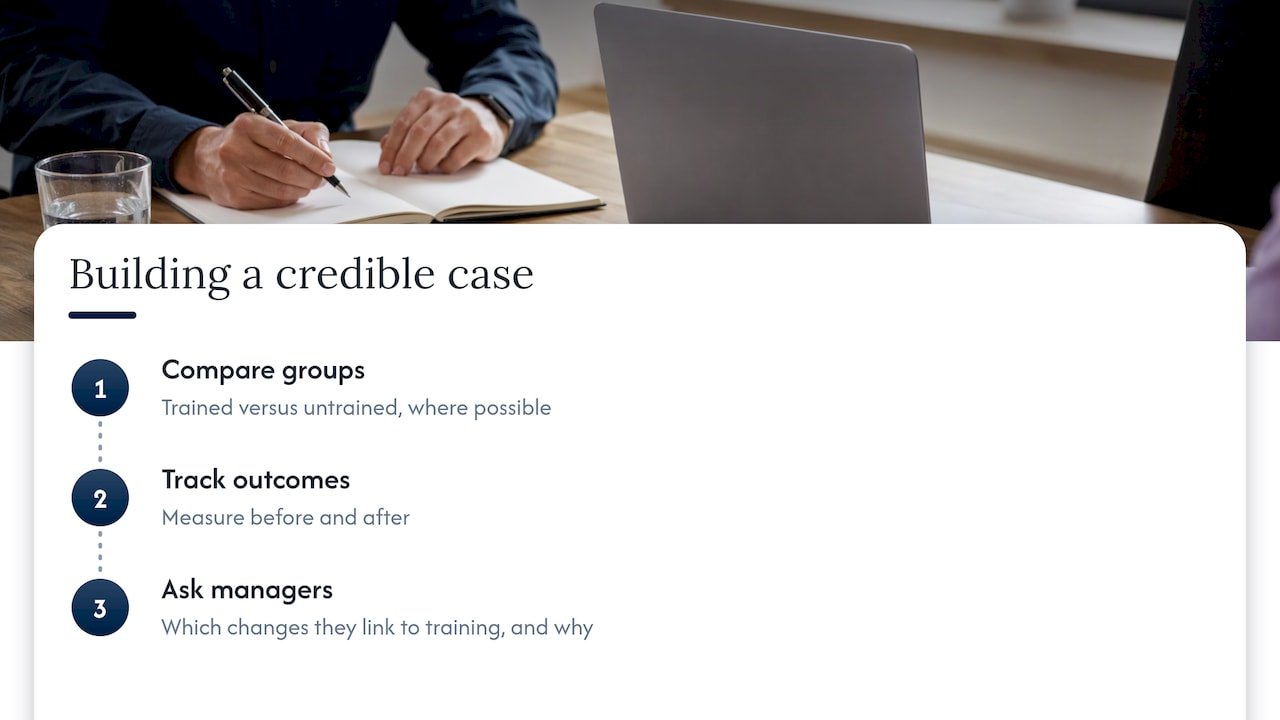
The sensible response is to build a credible case rather than claim certainty. Compare trained and untrained groups where you can, track the metric before and after, and ask managers which changes they link to the training and why.
How to use the model to evaluate a training programme
The most useful habit is to work backwards. Many teams start by collecting reaction forms and only think about results at the end, when the data they need was never captured.
- Define the result. Agree with the sponsor which business outcome the training is meant to move, and how it is measured today. “Fewer rework hours on site” is a result. “Better communication” is not yet one.
- Name the behaviours. List the few critical on-the-job actions that would produce that result.
- Set learning objectives. State what people need to know, be able to do and feel confident about to perform those behaviours.
- Design delivery and feedback. Build the course around those objectives and decide what Level 1 will ask.
- Plan the data collection. Decide who gathers each measure, when, and where it is stored, before the first session.
- Report as a chain. Present the four levels together, showing how reaction, learning, behaviour and results connect, and where the chain broke if it did.
A short note on terminology: you may see the process described as five steps of training evaluation in some guides. The wording differs between authors, but the sequence is similar: set goals, choose measures, collect data, analyse it and act on what you find. The four levels sit inside that sequence.
Kirkpatrick model examples
The examples below are illustrative scenarios showing how the measures might look, not case studies of real organisations.
Example 1: Project management course
A delivery team attends a course on risk management.
- Level 1: a short survey on relevance to current projects.
- Level 2: a scenario test in which participants rank and respond to a set of project risks, taken before and after.
- Level 3: six weeks later, a programme manager checks whether risk registers are being updated at each review and whether mitigation owners are named.
- Level 4: over the following quarters, the team tracks late-delivery incidents and unplanned cost changes against the previous year.
If your team is working towards accredited project management qualifications, our project management courses are one route to the Level 2 evidence you need.
Example 2: Safety and compliance training
A facilities team completes training on a new safety procedure.
- Level 1: participants rate how well the scenarios matched their site.
- Level 2: a practical assessment where each person walks through the procedure.
- Level 3: supervisors use a checklist on walk-rounds to see whether the steps are followed.
- Level 4: the team tracks reported incidents and near-misses over time.
Safety is a good fit for the model because the behaviour is specific and observable, and the result is already recorded in most organisations.
Example 3: Facilities and workplace services
A facilities department trains staff to measure and report performance. Level 3 looks at whether reports are produced to the agreed format and used in meetings, while Level 4 looks at service quality and cost indicators. Courses such as Security Performance Measurement and Reporting and Post-Occupancy Evaluation for Facilities Management give teams the skills that produce the data these measures depend on.
Connecting evaluation to behaviour and business results
The gap between Level 2 and Level 3 is where most training value is won or lost. Four practical moves close it.
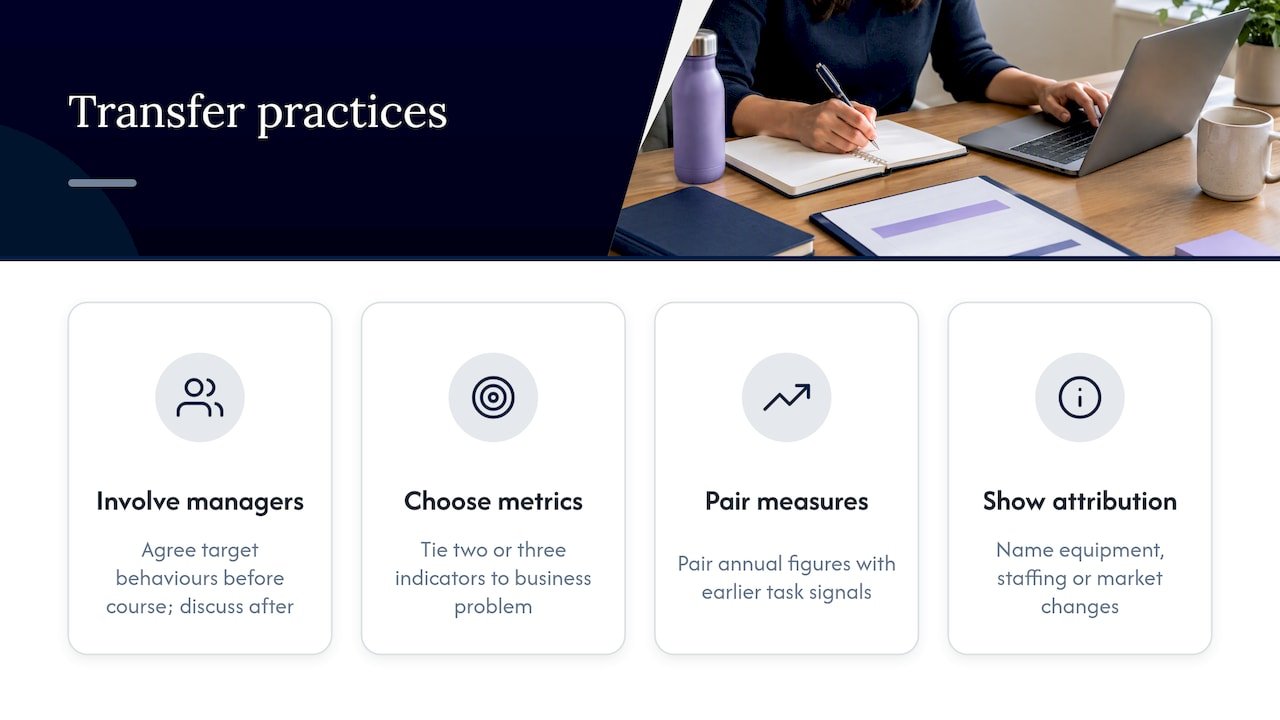
Involve the line manager early. The manager sees the work. If they agree the target behaviours before the course and discuss them afterwards, transfer is far more likely than if training is treated as a separate event.
Choose a few metrics, not many. Two or three indicators tied to the original business problem are easier to defend than a dashboard of twenty.
Use leading and lagging measures. Annual figures arrive too late to correct a poor programme. Pair them with earlier signals, such as the share of observed tasks done correctly in the month after training.
Be honest about attribution. Because improvements may not be directly or solely attributed to the programme, state what else changed in the period, such as new equipment, staffing or market conditions. Readers trust a measured claim more than an inflated one.
Strengths and limits of the model, and how to work with them
The model is valued for its simplicity and pragmatic structure, which is why practitioners keep using it. The same review notes a lack of evidence for the causal links the levels imply, and a tendency to overlook context. In practice this means treating the levels as a planning and reporting structure rather than a law of cause and effect.
To get the most from it:
- Collect context data, such as manager support and workload, alongside the four levels.
- Do not stop at Level 1 because it is easy.
- Do not wait until the end to decide the Level 4 measure.
- Report findings you can act on: what to change in content, delivery or workplace support.
Our perspective
In our experience, evaluation is decided before training starts, not after it ends. The organisations that can show Level 3 and Level 4 evidence are those that agreed the business problem first and built the course around it.
That is why we focus on customisable programmes. Generic content rarely matches a team’s real procedures, tools and risks, and relevance is exactly what Levels 1 and 3 test. We design training around organisation-specific challenges, delivered on site, online or blended, so people practise on the situations they will actually meet.
We also encourage clients to involve line managers in the plan from day one. Expert-led, accredited training gives you strong Level 2 evidence. Manager follow-up turns it into Level 3 behaviour, and that is where results begin.
Sam
Plan training you can evaluate
If you are choosing training for a team and want it to produce evidence at every Kirkpatrick level, start with the outcome you need and work back. Oxford Centre offers professionally accredited courses across project management, healthcare, oil and gas, civil engineering, IT, leadership, compliance and safety, with content that can be tailored to your organisation and delivered on site, online or blended.

Browse the full course catalogue or see our project management training to discuss a programme built around the results you want to measure.
FAQ
What are the Kirkpatrick levels 1 to 4?
They are Reaction, Learning, Behaviour and Results. Reaction covers how participants felt about the training, Learning covers what they gained, Behaviour covers what they do differently at work, and Results covers the effect on the organisation.
Which level evaluates whether participants see the training as relevant to their jobs?
Level 1, Reaction. It measures the degree to which participants find the training favourable, engaging and relevant to their jobs. Ask about relevance directly, not just overall satisfaction.
Do I have to evaluate all four levels for every course?
No. Levels 1 and 2 suit almost every course because they are quick to gather. Reserve the effort of Levels 3 and 4 for training tied to an important business outcome, such as safety, quality or delivery, where the investment in follow-up is justified.
Why is Level 4 so hard to measure?
It needs follow-up over the medium and long term, and it must separate the effect of training from other influences. Research describes it as the most challenging stage. Agreeing the metric before training begins makes it much more manageable.
Sources
- Kirkpatrick Model (evaluation model), EBSCO Research Starters
- Kirkpatrick’s Four Levels of Evaluation, ATD
- 6.5 Evaluating Training, Introduction to Human Resource Management
- Kirkpatrick and Beyond: A review of models of training evaluation, Institute for Employment Studies
- Employing Kirkpatrick’s framework to evaluate nurse training, PubMed Central