
Behaviour-based safety training teaches supervisors and crews to observe work, give real-time feedback, and reinforce safe actions so at-risk behaviours drop before they become incidents. It works as a leading-indicator system, not a hazard control. Used well, it strengthens safety culture and gives leaders data they didn’t have before; used alone, without engineering controls and hazard elimination, it leaves real risks untouched.
TL;DR:
- BBS programs should focus on data-driven behavior selection, with clear, observable checklists and calibrated observers to ensure trustworthy data.
- Piloting the checklist with paired observers and iterative improvements yields more accurate results and sustained program success.
- Leadership involvement and consistent data review are critical to maintaining momentum and preventing the program from devolving into paperwork.
- Combining on-site, online, and blended training formats with accredited courses enhances observer competency and scalability across multiple sites.
- Leading indicators like observation rates and behavior percentages are effective for tracking program health, but safety outcomes depend on consistent implementation over time.
Table of Contents
- What is BBS training? Understanding the ABC model
- Core components every BBS programme needs
- Building a BBS programme: the implementation sequence
- Observation checklists: the practical rules that make or break your data
- Measuring what matters: KPIs and dashboards for BBS
- Training design: building observers who actually observe well
- Where accredited training fits into a BBS rollout
- What actually drives BBS programmes to succeed
- How Oxfordcentre supports your BBS rollout
- Standards and guidance worth keeping close
- Sources
What is BBS training? Understanding the ABC model
Ask five safety managers what BBS training means and you’ll get five slightly different answers, but the core mechanic is consistent: it’s built on the ABC model. Antecedent is what triggers a behaviour (a rushed deadline, a missing guard rail, peer pressure to skip a step). Behaviour is the observable action itself, safe or at-risk. Consequence is what follows, and consequences shape whether that behaviour repeats. Get the consequence side right, meaning immediate, specific, and mostly positive feedback, and behaviour shifts faster than most safety officers expect.
This is where behavioural safety training diverges from a hazard-first approach. Hazard-first thinking asks “what could hurt someone here?” and engineers the risk out. BBS asks “what is someone actually doing, and why?” Both matter, but they solve different problems. A guard rail removes a fall hazard regardless of who’s working that day. A BBS observation catches the worker who’s stopped clipping onto the anchor point because it slows them down.
Organisations typically adopt behavioural safety programmes to achieve a specific set of outcomes:
- Reduce at-risk behaviours identified through incident and near-miss data
- Build a two-way feedback culture between the workforce and supervisors
- Generate leading indicators that predict trouble before injuries occur
- Strengthen ownership of safety at the crew level, not just from the safety office
Core components every BBS programme needs
A programme built on good intentions but no structure collapses within a few months. Every durable behaviour-based safety training initiative rests on five components.
- Behaviour selection grounded in data. Pull your target behaviours from incident reports, near-miss logs, and audit findings, not from a generic industry list. If a large proportion of your recordable injuries trace back to manual handling, your checklist should reflect that, not generic housekeeping items.
- Concise, observable checklists. Each item must describe something an observer can see, not infer. “Uses proper lifting technique” is vague. “Bends knees, keeps load close to body” is observable.
- Trained, calibrated observers. Untrained observers introduce bias almost immediately, rating the same behaviour differently depending on who’s watching. Calibration exercises fix this before it damages your data.
- Feedback and reinforcement systems. Feedback needs to happen at the point of observation, framed around the behaviour, and paired with specific goals the crew can act on.
- Leadership governance. Someone senior needs to review the data on a set cadence and act on what it shows, or the programme becomes paperwork.
Skipping any one of these tends to show up quickly. Programmes without governance drift into box-ticking within a quarter; programmes without calibrated observers produce data nobody trusts. Industry implementer guidance consistently ties sustained safety improvement back to this kind of governance and structured reporting, not to the observation activity alone.
Building a BBS programme: the implementation sequence
Rolling out behaviour-based safety training works best as a sequence, not a launch event. Rushing straight to full-site observations without piloting is the single most common reason programmes stall in year one.
- Define scope and align with existing safety KPIs. Decide which sites, teams, or contractors are in scope, and connect the programme’s goals to whatever safety metrics leadership already tracks. If your organisation reports TRIR quarterly, your BBS metrics need to speak the same language.
- Analyse incidents and near misses to select initial target behaviours. Three to seven behaviours is usually the right range for a first pass. More than that and observers lose focus.
- Pilot the checklist on a small scale. Run it with one or two crews for two to four weeks. Expect to revise items you thought were clear but turned out ambiguous in the field.
- Train observers, then pair them for mentored observations. New observers shadow experienced ones before working solo. This single step does more to fix inter-observer variation than any amount of written instruction.
- Aggregate data and set behaviour-based goals. Once you have a few weeks of reliable data, set specific targets (for example, raising safe-behaviour percentage on a named task from 70% to 85% over a quarter) and review trends monthly with leadership.
Pro Tip: Run your pilot with paired observers watching the same task independently, then compare their scores side by side. Where scores diverge, that item’s definition needs rewriting before you scale up. This single exercise catches most of the ambiguity that would otherwise poison your data for months.
Programmes that treat this as iterative, rather than a one-off rollout, tend to outperform. The Certainty implementation model frames sustained BBS activity as a continual improvement loop feeding leading indicators back into planning, which matches what most experienced practitioners find works: the programme is never really “finished,” it just gets more accurate over time.
Observation checklists: the practical rules that make or break your data
The checklist is the instrument, and like any instrument, a badly calibrated one produces confident-looking nonsense. A few rules separate checklists that generate trustworthy data from ones that generate noise.
- Fit it on one sheet. If your observers need to flip pages mid-task, you’ll lose observations to the paperwork itself.
- Put definitions on the back. Every item that could be interpreted two ways needs a one-line clarification observers can check on the spot.
- Choose a sampling approach deliberately. Task-based sampling (watching a specific job start to finish), zone-based sampling (observing whoever’s working in a defined area), and rotation (cycling observers across shifts and crews) each surface different blind spots. Most mature programmes use a mix.
- Run calibration workshops before scaling. Get several observers to rate the same recorded or live task, then compare notes. Disagreements point straight to the checklist items that need rewriting.
- Strip out punitive language entirely. An item phrased like a citation (“failed to wear PPE”) invites defensiveness. Rephrased as an observable fact (“not wearing hearing protection”), it invites conversation instead.
Practitioner guidance on checklist design is consistent on this point: shorter, pilot-tested checklists with clear definitions beat long, exhaustive ones almost every time, because observers actually use them correctly.
Pro Tip: Cap your checklist at 10 to 12 items for any single observation. Beyond that, observers start skimming rather than genuinely watching, and your safe-behaviour percentage becomes a measure of attention span, not safety.
Measuring what matters: KPIs and dashboards for BBS
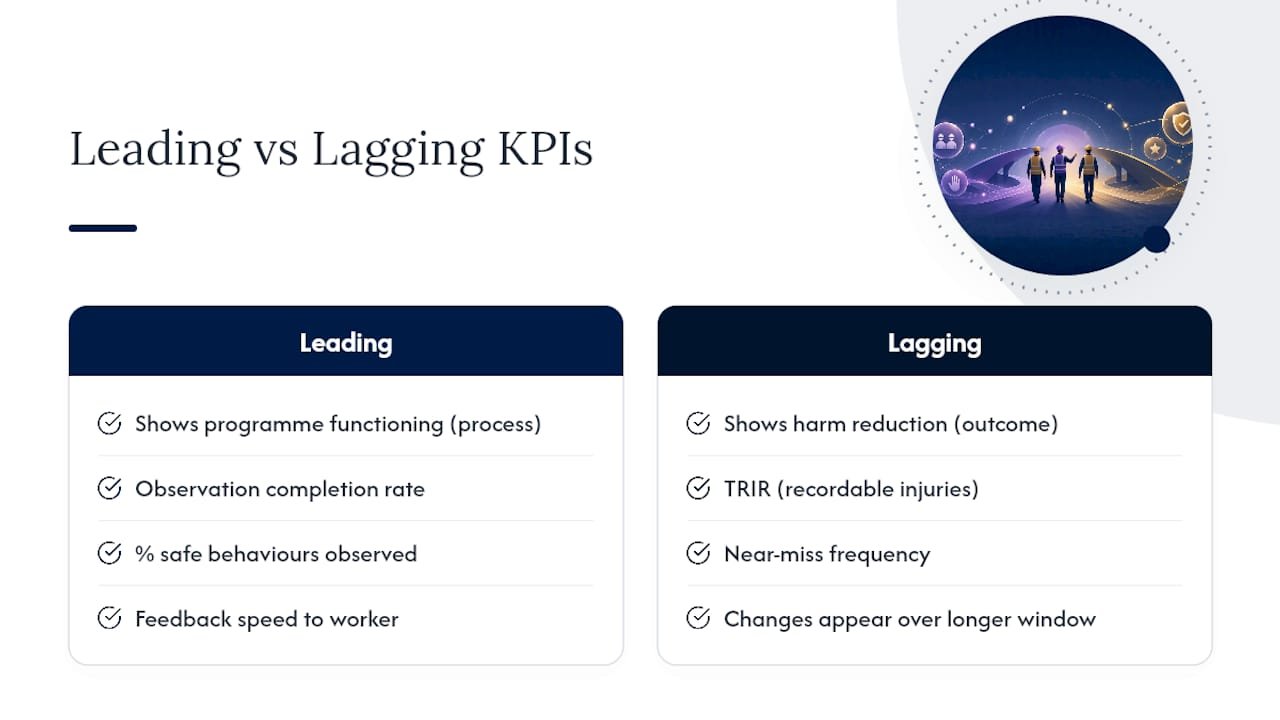
Two categories of indicator matter here, and mixing them up leads to bad decisions. Leading indicators, observation completion rate, percentage of safe behaviours observed, and how quickly feedback reaches the worker after an observation, tell you whether the programme is running as designed. Lagging indicators, TRIR and near-miss frequency, tell you whether it’s actually reducing harm, but only over a longer window.
Some studies report meaningful reductions in recordable injury rates tied to sustained BBS observation programmes, though effect sizes vary considerably depending on how consistently the programme runs and how the organisation’s baseline risk looked to start with. Correlating leading and lagging indicators too tightly, too early, is a common mistake; a single quarter of improved observation scores rarely shows up in TRIR yet.
Simple visual dashboards, a bar chart on a noticeboard showing safe-behaviour percentage by week, tend to move behaviour faster than detailed spreadsheets buried in a shared drive. DEKRA’s programme data points to visible, frequent feedback loops as a consistent driver of engagement. Guard against gaming, too: if observers know a low score reflects badly on their crew, scores drift upward for reasons that have nothing to do with actual behaviour change.
Training design: building observers who actually observe well
Course design for BBS needs to target two distinct audiences with overlapping but not identical skills: the observers doing the watching, and the coaches or supervisors delivering feedback. Observers need to learn how to spot behaviours objectively without letting personal relationships colour what they record. Coaches need to learn how to open a feedback conversation without triggering defensiveness, which is a genuinely different skill from spotting the behaviour in the first place.
Strong course design mixes formats rather than relying on one:
- Role play for practising feedback conversations before they happen on a live site
- Supervised field observations, where a trainee observes alongside a mentor and compares notes afterwards
- Calibration exercises, watching recorded footage and scoring it independently against the group
- Refresher sessions triggered by data trends, not just a fixed calendar date, so training responds to what’s actually happening on site
On-site delivery suits crews where hands-on calibration matters most; blended and e-learning formats work well for the theory components and for organisations training observers across multiple locations. Implementation guidance consistently recommends practical exercises over lecture-style delivery, and refreshing training whenever observation data shows drift or when the work itself changes significantly.
Where accredited training fits into a BBS rollout
Course quality varies enormously across providers, which is exactly why accreditation criteria exist. IACET’s accreditation standards set expectations for learning outcomes and assessment rigour that a serious BBS course should meet, whether it’s delivered on-site, online, or blended. Safety and compliance courses structured around measurable competency outcomes rather than seat time matter more in BBS than in most training categories: an observer who’s sat through a session but can’t calibrate consistently against a colleague hasn’t actually gained the skill the programme depends on.
Flexible delivery, on-site for crews who need hands-on calibration practice, online or blended for multi-site organisations training observers across regions, lets safety teams scale observer competence without pulling entire shifts off the floor at once. That flexibility, paired with accredited course design, is where measurable engagement and skill gains tend to show up fastest.

What actually drives BBS programmes to succeed
Three factors separate programmes that stick from ones that fade after six months: visible leadership commitment, rigorous observer calibration, and a measurement system leadership actually reviews. Skip any one and the programme drifts into paperwork. Leadership commitment is the one most often underestimated. Crews notice within weeks whether managers act on the data or file it away.
The most common failure mode isn’t a bad checklist, it’s launching site-wide before piloting, which locks in ambiguous items across an entire workforce before anyone catches the problem. Organisations that pilot first and calibrate hard typically see safe-behaviour percentages climb steadily over a few months, not because the workforce changed overnight, but because the checklist finally measures what it’s supposed to measure.
— Sam
How Oxfordcentre supports your BBS rollout
Building observer competence at scale is where most BBS programmes lose momentum, and it’s exactly the gap accredited training is designed to close.

Oxfordcentre delivers safety and compliance courses on-site, online, or blended, so you can train a handful of observers at one facility or calibrate teams across several sites without pulling everyone off the floor simultaneously. Courses are built around measurable competency outcomes, meaning your organisation gets observers who can genuinely calibrate against each other, not just staff who’ve completed a session. If you’re planning a pilot rollout or scaling an existing programme, get in touch through the Oxfordcentre course catalogue with your team size, preferred format, and target sites, and start the enquiry from there.
Standards and guidance worth keeping close
- OSHA’s safety and health programme guidelines for where BBS fits alongside hazard elimination
- ISO 45001 clauses on competence and communication, which align directly with BBS governance
- IACET accreditation criteria for evaluating training providers
Sources
- OSH A: Safety and health programme management guidelines
- IACET: Why accreditation matters
- Safety Training Tip: Behavior Based Safety (BBS Program) – HSI
- How to Implement BBS Training | Certainty
- Behavior-Based Safety (DEKRA)