
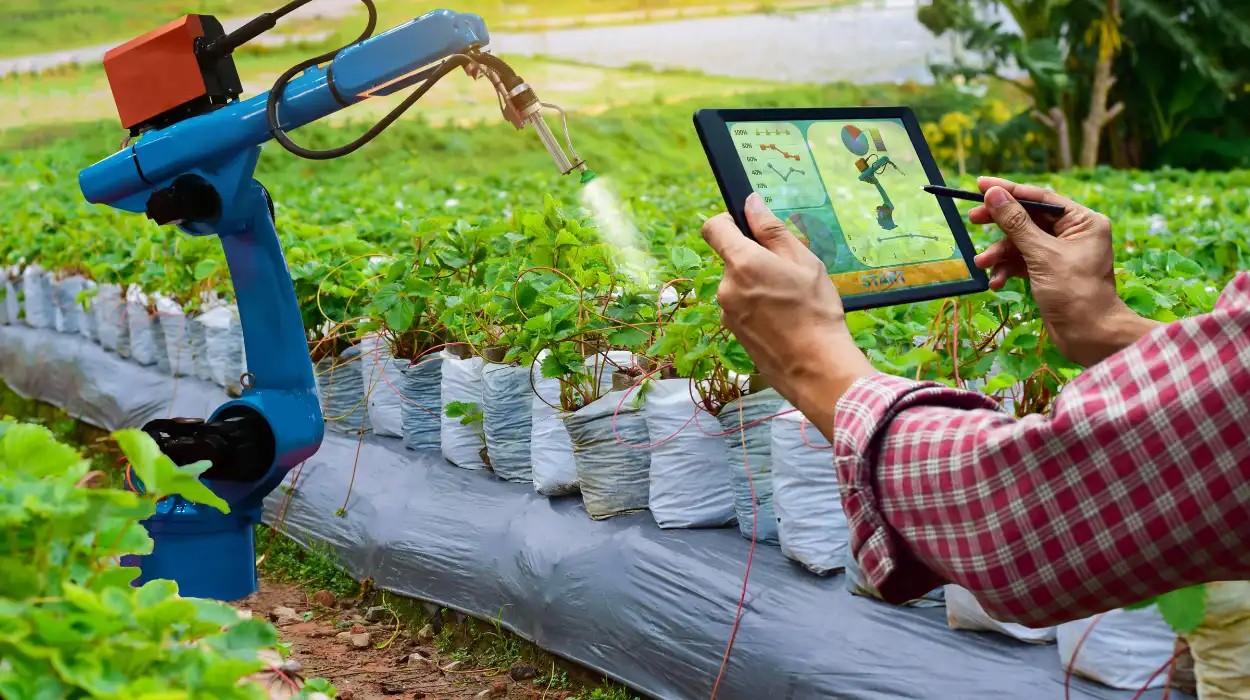
Agriculture is going through one of the most significant transformations in its history. Farmers across the world—whether managing small family farms or large agricultural enterprises—are turning to technology to improve productivity, reduce waste, and adapt to changing environmental conditions. This shift is driven by rising global food demand, climate pressures, labour shortages, and the need for more sustainable farming practices. Understanding how smart farming works is no longer optional; it is becoming an essential part of modern agricultural success. As digital tools, data-driven strategies, and connected devices reshape the farming landscape, even beginners can benefit from understanding this rapidly evolving field.
This blog serves as a beginner guide to smart farming, breaking down complex concepts into simple language, exploring the foundations of precision agriculture basics, and explaining how smart farm management is applied in real-world agriculture. Whether you are an aspiring farmer, agriculture student, sustainability professional, or someone interested in the future of food production, this guide will walk you through everything you need to know about modern farming techniques and the technologies driving agricultural progress.
What Is Smart Farming? A Simple Introduction
Smart farming, also known as precision agriculture, refers to using digital technologies to improve agricultural efficiency, decision-making, and resource management. It is best understood as a system that combines data, automated tools, and connectivity to create a more controlled, sustainable, and productive farming environment. When people search for smart farming explained, they are typically looking for clarity about the technologies behind it and how these tools transform traditional farming practices.
The goal of smart farming is not to replace farmers but to give them powerful tools that support more accurate decisions. In traditional farming, decisions are often based on experience, observation, and historical patterns. In contrast, smart farming uses real-time data, sensors, predictive algorithms, and machine learning to optimise every stage of production—from soil preparation to planting, irrigation, fertilisation, harvesting, and storage.
How Smart Farming Works: The Core Concepts
To understand how smart farming works, it is important to look at the data-driven cycle that powers agricultural decision-making. At its core, smart agriculture technologies collect data from multiple sources, convert that data into actionable insights, and integrate those insights into farming operations.
The process usually begins with environmental monitoring. Sensors measure conditions such as soil moisture, nutrient levels, temperature, pH, crop growth patterns, and weather forecasts. These sensors often rely on the IoT in agriculture, where devices communicate with each other and send data to central systems for analysis. Once the data is collected, advanced analytics tools and AI models process the information to reveal patterns, predict problems, and recommend specific actions.
These insights then guide targeted decisions—such as adjusting irrigation levels to avoid water waste, applying fertiliser only where nutrient deficits exist, or using drones to detect early signs of crop stress. This shift from reactive to proactive management defines the true advantage of smart farm management.
Precision Agriculture Basics: The Foundation of Smart Farming
One of the most important components of smart farming is precision agriculture. Understanding precision agriculture basics helps beginners see how technology merges with traditional farming knowledge. Precision agriculture focuses on treating every part of the farm according to its unique needs rather than applying the same treatment across entire fields.
In traditional farming, farmers may irrigate entire fields uniformly, even though different areas have different water requirements. Precision agriculture uses detailed soil and crop data to deliver water exactly when and where it is needed. The same concept applies to seeds, fertilisers, pesticides, and machinery usage.
By applying inputs more efficiently, farmers reduce costs, improve yields, and minimise environmental impact. This is especially important as climate change intensifies and water scarcity becomes a growing challenge. Precision agriculture forms the backbone of modern farming techniques and enables sustainable long-term food production.
Smart Agriculture Technologies That Power Modern Farming
Smart farming relies on a wide range of digital farming tools and technological innovations. These tools help farmers automate tasks, reduce labour requirements, and improve accuracy. Some of the key technologies include sensors, drones, satellite imagery, robotics, automated irrigation systems, AI-powered analytics, weather forecasting apps, smart tractors, and remote monitoring systems.
Each technology plays a unique role. Drones, for example, provide high-resolution imagery that helps farmers assess crop health, detect diseases early, and estimate yield. Soil sensors deliver real-time data about moisture and nutrient levels, enabling precision irrigation and fertilisation. Satellite imaging supports large-scale monitoring, making it easier to observe crop variations across extensive fields.
These tools allow farmers to manage operations more effectively and respond quickly to crop needs. The integration of digital farming tools into everyday agricultural activities is reshaping the industry and enabling farmers to achieve higher productivity with fewer resources.
The Role of IoT in Agriculture
The IoT in agriculture is the backbone of smart farming. IoT devices connect sensors, equipment, drones, and machinery to one integrated network where data flows continuously between systems. These devices include weather stations, livestock trackers, soil sensors, smart irrigation controllers, and GPS-guided machinery.
IoT enables remote operation and monitoring of farm processes. For example, farmers can check moisture levels from their mobile phones, receive alerts about equipment failures, or automatically trigger irrigation when soil dries. This level of automation significantly improves efficiency and reduces manual effort.
Furthermore, IoT supports predictive analytics by gathering high-frequency data that models can use to forecast crop growth, pest risks, disease outbreaks, and yield estimates. This connectivity is transforming agriculture into a highly data-driven industry.
Smart Farm Management: Turning Data into Decisions
Technology alone cannot create farming success. The real power of smart farming lies in smart farm management, which refers to using data to guide every agricultural decision.
Smart farm management covers a wide range of activities, including crop planning, resource allocation, equipment management, risk forecasting, and supply chain coordination. It helps farmers adopt a strategic approach where decisions are based on accurate, real-time information rather than intuition alone.
This shift enables farmers to detect problems earlier, react to challenges faster, and make informed choices about planting schedules, irrigation cycles, fertiliser use, and pest control. The result is higher productivity, lower costs, and improved sustainability.
Modern Farming Techniques Enabled by Technology
Technology has introduced new modern farming techniques that enhance productivity and sustainability. These include vertical farming, hydroponics, automated greenhouses, controlled-environment agriculture, climate-smart farming, and regenerative agriculture supported by digital tools.
These innovations help farmers overcome environmental limitations, reduce chemical usage, protect soil health, and optimise climate conditions for crops. The introduction of automation has also transformed livestock farming through smart feeding systems, automated health monitoring devices, and AI-powered herd management tools.
Whether farmers operate in rural fields or urban environments, technology is enabling new ways of producing food efficiently and sustainably.
Agriculture Technology Trends Shaping the Future
The future of farming is being shaped by rapid advances in technology. Key agriculture technology trends include AI-driven decision support systems, autonomous farming machinery, robotics-based harvesting, blockchain for food traceability, climate prediction models, and gene-edited crop varieties.
With global agricultural challenges increasing, these technologies will play a crucial role in ensuring food security, improving water efficiency, and increasing crop resilience. Smart farming will continue to evolve, introducing more advanced tools that simplify operations and improve outcomes for farmers worldwide.
Why Beginners Should Learn Smart Farming
For beginners, understanding introduction to smart farming concepts opens doors to a wide range of agricultural career opportunities. As global demand for skilled agriculture professionals grows, expertise in digital farming tools, precision farming, and sustainable agriculture is becoming highly valuable.
Students, new farmers, environmental specialists, and agricultural workers can all benefit from learning how smart farming works. The combination of environmental knowledge, technological awareness, and smart farm management skills prepares individuals for careers in modern agriculture and environmental management.
Final Thoughts
Smart farming is transforming the future of agriculture by combining digital innovation, scientific insights, and sustainable practices. Understanding how smart farming works equips beginners and professionals alike with the knowledge needed to improve crop performance, reduce waste, and make informed farming decisions. As organisations adopt advanced farming technologies, the demand for skilled professionals who understand precision agriculture and digital farming continues to grow. Developing these skills through specialised Environmental & Agriculture Training Courses provides the foundation needed to succeed in modern agriculture. The Oxford Training Centre supports learners and professionals in gaining practical skills that empower them to contribute effectively to the future of farming and sustainability.